Keeping track of a dog can be challenging, especially when exploring unfamiliar trails, visiting busy parks, or spending time in areas where the dog may wander out of sight. Although collars, identification tags, training, and supervision remain important, technology can provide another way to understand a dog’s whereabouts.
A GPS dog tracker can help owners view their dog’s reported location, review previous movements, and, on supported devices, receive alerts when the dog crosses a predefined boundary. These functions can be useful during everyday walks and outdoor adventures, as well as when a dog unexpectedly wanders away.
However, the benefits of GPS dog tracking depend on how the device works, how location information reaches the owner, and which features the system supports. Some trackers provide smartphone-based location updates, while others use dedicated receivers or alternative communication methods.
In this guide, we’ll explore the main benefits of using a GPS dog tracker, explain how these devices support location awareness, and examine what owners should understand about their capabilities and limitations.
What Is a GPS Dog Tracker?
A GPS dog tracker is an electronic device, commonly attached to a dog’s collar or harness, that helps determine and report the dog’s location. Many devices use signals from Global Positioning System (GPS) satellites to calculate their position.
The tracker then uses a supported communication method to make that location information available to the owner. Depending on the system, this might involve a cellular network and smartphone app, a dedicated handheld receiver, or another communication arrangement.
It is important to distinguish between GPS positioning and location transmission. GPS satellites help the receiver calculate its position, but they do not automatically send the dog’s coordinates directly to the owner’s cell phone. A separate communication system is needed to deliver the information.
When the tracker and its communication system are working as intended, owners can view the reported location and, on some devices, access additional features such as location history or geofencing alerts.
What Are the Main Benefits of Using a GPS Dog Tracker?
The benefits of using a GPS dog tracker extend beyond viewing a location on a map. Depending on the device, tracking technology can support outdoor monitoring, provide useful information during a search for a missing dog, and help owners understand their dog’s movements over time.
1. Greater Awareness of Your Dog’s Location
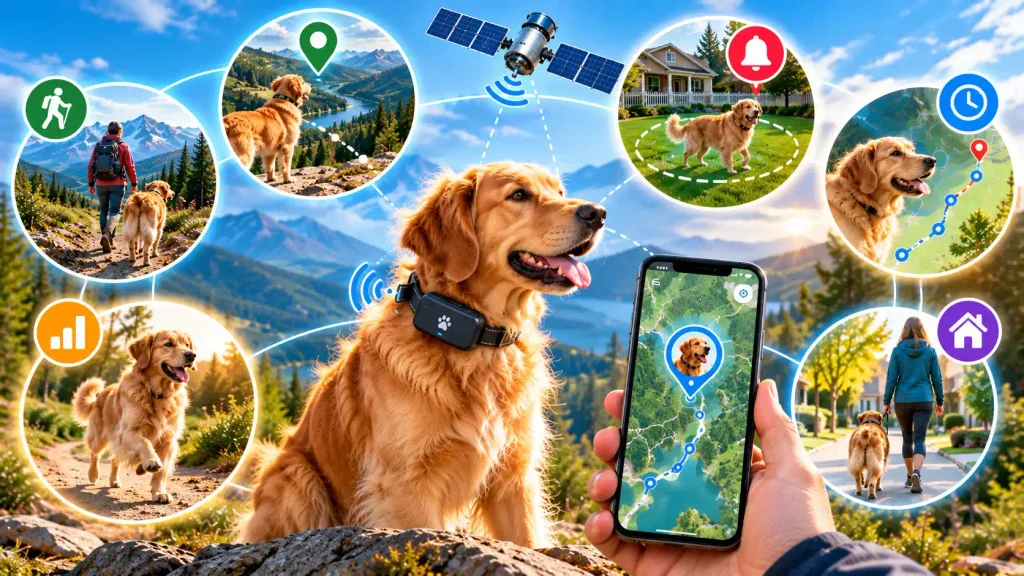
One of the primary benefits of a GPS dog tracker is the ability to check a dog’s reported position without relying entirely on direct visual contact.
For example, imagine walking your dog through a large park. Your dog moves ahead along a trail and briefly disappears behind a group of trees. If your tracker is functioning and sending recent updates, its app or receiver may help you determine the dog’s approximate location.
This information can be particularly useful in unfamiliar surroundings, where landmarks may be difficult to recognize or a dog may move beyond the owner’s immediate view.
The usefulness of location information depends on how recently the tracker updated its position. A marker shown on a map may represent the last location successfully received rather than the dog’s exact current position. Checking the update timestamp helps you interpret the information more accurately.
2. Support When Searching for a Missing Dog
A GPS dog tracker may provide valuable information if a dog escapes from a yard, slips out of a collar, or wanders away during an outdoor activity.
If the device continues reporting its location, the owner may be able to identify the dog’s approximate position and follow its movements. Some systems also maintain location history, which can help show where the dog traveled before the latest update.
For example, suppose your dog gets loose near a walking trail. A recent location update may help narrow the area you need to search. If updates stop, the last-known location and any available route history may provide additional clues.
However, tracking information is a guide, not a guarantee. The dog may have moved since the last update, the device may have lost connectivity, or its battery may have run out.
If a dog goes missing, owners should combine available tracking information with practical search steps, such as contacting local animal shelters, notifying relevant local services, and asking nearby people for assistance. A registered microchip and a current identification tag can also help if someone finds the dog.
3. More Confidence During Outdoor Activities
GPS dog tracking can be useful when walking, hiking, camping, or exploring unfamiliar outdoor locations with a dog.
In large parks, open trails, and wooded areas, dogs may move ahead, follow interesting scents, or briefly leave their owner’s line of sight. A tracker can provide additional location awareness when its positioning and communication systems are operating correctly.
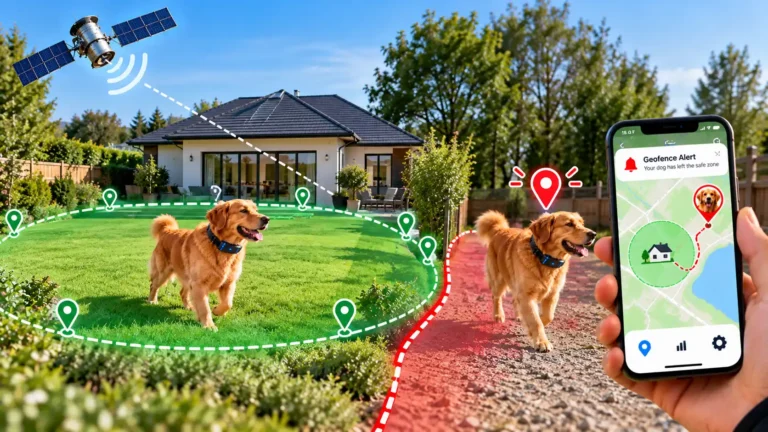
Some devices also support geofencing, which allows owners to establish a virtual boundary around a selected area. If the dog crosses that boundary, the system may send an alert, provided the feature is supported and the required location updates and communication are available.
For example, an owner camping in a designated area might use a supported geofence to receive a notification if the dog moves beyond the configured boundary. This can provide an additional source of information, but it does not physically prevent the dog from leaving the area.
A GPS tracker should therefore complement appropriate supervision, recall training, and the use of a leash where necessary. Outdoor conditions can affect positioning and communication, so owners should understand how their particular tracking system operates before relying on it in remote locations.
4. Access to Location History and Previous Routes
Some GPS dog trackers record location history, allowing owners to review previously reported positions or routes.
Depending on the device, this information may appear as a series of map markers or a route showing where the dog traveled during a particular period. Location history can help owners understand their dog’s usual walking patterns and identify places the dog frequently visits.
For instance, if you regularly walk your dog through a neighborhood, saved route information may help you review which streets or paths you covered. During a search, previous locations may also offer useful context about the dog’s movements before the latest update.
However, location history is not necessarily a continuous record of every movement. Many devices report positions at intervals, so a saved route may contain gaps between recorded points. The amount of history retained and how it can be accessed also vary by system.
Location history is most useful when understood as a record of reported positions rather than a complete account of everything a dog did.
5. Helpful Alerts Through Geofencing
Geofencing is a feature available on some GPS dog tracking systems. It allows owners to define a virtual boundary around a location, such as a yard, home, or designated outdoor area.
When the system detects that the dog has crossed the configured boundary, it may send an alert through the tracking app or another supported notification method.
This can help owners notice certain movements without continuously watching the tracking map. For example, a boundary alert may notify an owner when a dog moves outside a designated area during an outing.
Geofencing does have limitations. Alert timing depends on factors such as location-update frequency, positioning accuracy, communication availability, and device settings. A notification may arrive after the dog has already crossed the boundary.
Not every GPS dog tracker supports geofencing, and some systems may require an active service or compatible app. Owners should verify which features their device provides rather than assuming all trackers offer the same alerts.
6. A Better Understanding of Movement Patterns
Some tracking systems provide movement records or activity-monitoring features in addition to location information.
Location history may help owners understand where a dog travels, while supported activity features may estimate movement levels over time. Together, these functions can provide general insight into a dog’s daily routine.
For example, an owner might review recorded routes to understand which paths the dog follows most often or compare activity summaries from different days.
It is important to recognize that GPS location data and activity data are not the same. GPS positioning estimates where a device is located, while activity monitoring may rely on motion sensors or software calculations.
These records do not provide a complete assessment of a dog’s health or well-being. Activity estimates vary by device and should not be treated as a diagnosis or a substitute for veterinary advice when concerns arise.
7. Useful Information for Everyday Routines
For owners who regularly walk their dogs in different locations, tracking information may help organize and review everyday activities.
Depending on the device, saved routes can show where a dog has traveled, while location updates can provide additional awareness during walks or visits to unfamiliar places. Some systems also offer activity summaries or notifications that help owners review selected aspects of their dog’s routine.
For example, an owner may use route history to remember a walking path or review where the dog traveled during an outing. These records can be informative without requiring the owner to observe every movement directly.
The available information depends on the tracking system. Some devices focus primarily on location, while others provide a broader set of features. Owners should check the device’s specifications to understand what information is recorded and how it can be accessed.
Using GPS Tracking During Outdoor Activities
Outdoor activities are one situation in which GPS dog tracking may be particularly useful. Dogs can move quickly, follow scents, and explore beyond their owner’s immediate view, especially in unfamiliar surroundings.
During a hike, a tracker may help an owner check the dog’s reported location while moving along a trail. At a large park, it may provide additional information if the dog moves behind trees or beyond a bend in the path. During camping trips, supported geofencing features may offer alerts when a dog crosses a configured boundary.
The practical value of these features depends on the environment and the tracking system. Open areas may provide favorable conditions for satellite reception, while dense vegetation, steep terrain, and other obstructions can affect positioning. A cellular-dependent tracker may also have difficulty sending updates where mobile coverage is weak or unavailable.
Before visiting an unfamiliar area, owners should understand the device’s communication requirements, check its battery level, and confirm that recent location updates are available. A successful test at home does not guarantee identical performance in a remote location.
GPS tracking is an additional source of information, not a replacement for supervision. A leash, appropriate training, secure equipment, and awareness of local hazards remain important when spending time outdoors with a dog.
Understanding Location History
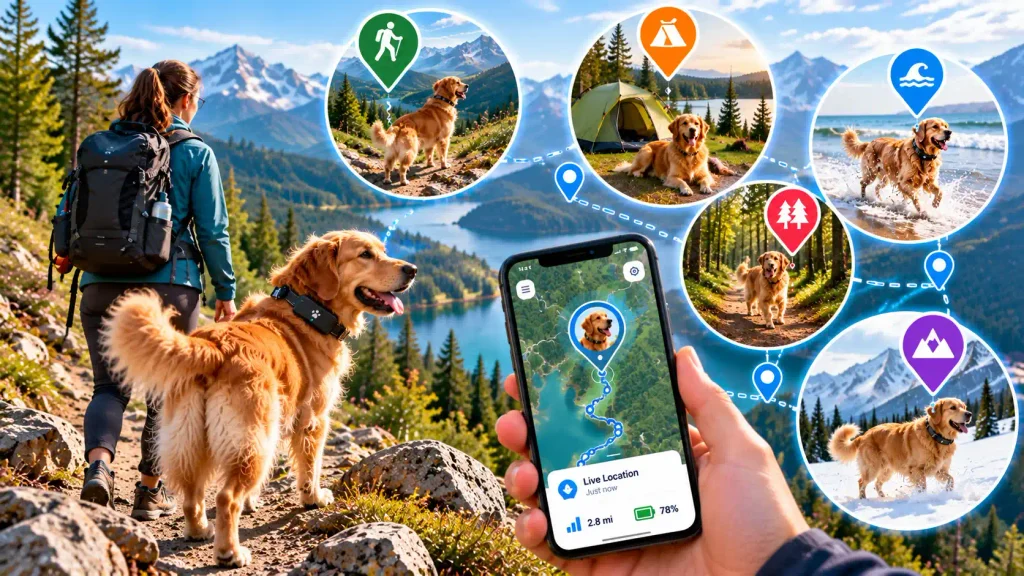
Location history is one of the more useful features offered by some GPS dog tracking systems. It allows owners to review previously recorded positions rather than seeing only the latest available location.
Depending on the device and service, location history may help owners:
- Review routes taken during a walk or outdoor outing.
- Identify areas a dog visits repeatedly.
- Understand the sequence of reported positions before an update interruption.
- Examine available location records when searching for a missing dog.
- Keep a general record of past movements.
Consider a dog that regularly walks through a large neighborhood park. Reviewing saved location records may help the owner recognize familiar routes and see which areas the dog visited during previous outings.
However, location history has limitations. If the tracker records positions at intervals, it may not capture every turn or movement. Some devices store records for only a limited period, and connectivity interruptions may affect which information reaches the app.
Location history should therefore be interpreted as a record of reported locations. It can provide helpful context, but it does not necessarily reveal every action the dog took or establish exactly where the dog is now.
Benefits Depend on the Tracking System
Not every GPS dog tracker provides the same capabilities. The benefits available to an owner depend on the device’s positioning technology, communication method, software, settings, and any service arrangements required for its operation.
For example, a cellular-based tracker may transmit location information through a mobile network to a smartphone app. Another system may use a dedicated handheld receiver or a different communication method. These systems can behave differently when used outside cellular coverage.
The table below summarizes common features and their potential benefits.
| Feature | Potential benefit | Important consideration |
|---|---|---|
| Current location updates | Helps owners check the dog’s reported position | Updates may be delayed or unavailable |
| Location history | Provides records of previously reported locations | Recording frequency and retention vary |
| Geofencing | Can notify owners when a dog crosses a virtual boundary | Requires supported features and timely updates |
| Activity monitoring | May provide general estimates of movement | Not available on every device and not a medical assessment |
| Battery status | Helps owners monitor remaining power | Battery life varies with usage and device design |
| Connectivity status | May help explain missing updates | Status indicators do not always identify the exact cause |
| Dedicated receiver support | May allow tracking without a cellular connection | Depends on receiver compatibility and communication range |
Some devices require a subscription for cellular connectivity or app-based services, while others use different arrangements. Owners should also check whether location history, geofencing, or other features require an active service plan.
Understanding these differences helps set realistic expectations. The benefits of GPS dog tracking are not determined by the term “GPS” alone; they also depend on how the complete tracking system works.
What GPS Tracking Does Not Guarantee
Although GPS dog trackers can provide useful location information, they have limitations that owners should understand.
First, tracking does not guarantee that a missing dog will be found. A tracker may lose power, become detached, lose communication, or stop providing reliable updates. Even when a location is available, the dog may have moved before the owner reaches the reported position.
Second, GPS positioning is not always exact. Satellite reception, physical obstructions, terrain, and device design can affect the calculated location. A map marker should be interpreted alongside its timestamp and the system’s connection status.
Third, not every tracker provides continuous live tracking. Some devices report positions at intervals, and some rely on cellular coverage or a compatible receiver to transmit location data. When communication fails, an app may show a last-known location rather than the dog’s current position.
Finally, a GPS tracker does not prevent a dog from escaping or entering a hazardous area. It should complement responsible supervision, appropriate training, secure fencing, visible identification, and a registered microchip.
The most useful way to view GPS tracking is as an additional source of information that can support responsible dog ownership, rather than a guarantee of safety or recovery.
Frequently Asked Questions About the Benefits of GPS Dog Trackers
Understanding the Benefits of GPS Dog Tracking
The benefits of using a GPS dog tracker center on improved location awareness and access to useful information about a dog’s movements. Depending on the system, owners may be able to check reported locations, review previous routes, receive geofencing alerts, and monitor selected activity information.
These capabilities can be particularly helpful during outdoor activities and when a dog unexpectedly wanders away. Location history may provide additional context during a search, while current updates can help owners understand where a dog was most recently reported to be.
However, the effectiveness of GPS dog tracking depends on the complete system, including positioning technology, communication availability, battery condition, software, and tracking settings. Not every device offers the same features, and location updates may be delayed or unavailable in some conditions.
Ultimately, GPS dog tracking is best understood as a practical information tool that can complement responsible dog ownership. When owners understand both its benefits and its limitations, they can interpret tracking information more carefully and use it as one part of a broader approach to keeping their dogs accounted for.