A good dog fence should give your dog room to explore while helping you maintain clear, consistent boundaries. For many dog owners, installing a traditional fence is not always practical. Large properties, uneven terrain, rental homes, and open rural land can make conventional fencing expensive or difficult to install.
GPS dog fences offer an alternative. They use satellite positioning and a compatible collar to establish virtual boundaries, allowing you to define where your dog can roam without burying wire around the property. Depending on the system, you may also get custom fence shapes, escape alerts, live tracking, and guided training features.
However, choosing the right system requires more than comparing features. Some collars focus on precise virtual containment without recurring subscription fees. Others combine containment with GPS tracking and structured training support. Conventional wireless fences provide another option for owners who prefer a simple circular boundary.

Quick answer:
A GPS dog fence is a collar that uses satellites to track your dog against a boundary you draw in a phone app. It warns your dog near the edge and, if the dog keeps going, applies a correction you choose. Collars start around $200 and often cost more, and some brands charge a subscription while others don’t. Most work best on properties of roughly one-third to three-quarters of an acre or larger.
Our picks at a glance
| Best for | Product | Subscription | Check price |
|---|---|---|---|
| Large properties, no subscription for fencing | SpotOn Nova | Not required for fences | Check Price |
| Guided training program | Halo Collar 5 | Required | Check Price |
| Lowest cost, no subscription | Dogtra GPS Fence | None | Check Price |
| Longest battery life (up to 70 hours) | PetSafe Guardian GPS 2.0 | Required | Check Price |
| Simplest setup, two dogs | PetSafe Wireless 2-Dog System Not GPS | None | Check Price |
Affiliate links: we may earn a commission at no extra cost to you. Prices and plans change, so confirm details on each brand’s page.
What is a GPS dog fence?
A GPS dog fence is a wireless pet containment system that needs no buried wire and no physical posts. Your dog wears a collar with a built-in GPS receiver. You set a virtual boundary on a map in a smartphone app, and the collar uses its satellite position to know when your dog is approaching or crossing that line.
Because the boundary is digital, you can draw it in almost any shape, from a simple circle to an irregular outline that follows your property lines. Most systems let you save more than one fence, so you can create a boundary for your yard, another for a relative’s house, and another for a campsite. Several also let you add keep-out zones, such as a pool, a garden or a driveway, inside a larger fence.
It helps to be clear about what a GPS fence is not. It is a training tool, not a physical barrier. A GPS fence cannot physically stop a determined or highly distracted dog from running past the boundary. It works because the dog learns what the warning cues mean and chooses to stay inside. That is why every reputable brand pairs the collar with a training program and recommends supervising your dog while it learns.
GPS fences are popular with owners of large properties, farms and rural homes, where building a physical fence would cost thousands of dollars or isn’t practical. They also appeal to renters and people who move often, because the fence goes wherever the collar goes.
How a GPS dog fence works
Although each brand adds its own features, nearly every GPS dog fence follows the same basic sequence.
- You draw the boundary. In the app, you trace your fence on a map or walk the perimeter with your phone. Walking the line can improve precision on irregular lots. Some brands also let you add warning zones, backup fences and keep-out areas.
- The collar finds its position. The collar reads signals from multiple GPS satellites to calculate where it is. Newer collars use dual-frequency receivers, which help reduce errors caused by signals bouncing off trees and buildings.
- Your dog gets a warning. As your dog approaches the edge, the collar sounds a tone or vibrates. Several systems use a warning zone inside the main fence, so the dog gets an early signal before it reaches the boundary.
- A correction follows if the dog keeps going. Depending on the product and your settings, this can be a stronger vibration or static stimulation at a level you control. Some collars, such as Dogtra’s, turn corrections off when the dog heads back inside, so returning home is never punished.
- Training makes the system work. Dogs learn what the cues mean over a few weeks of short daily sessions. SpotOn reports that trained dogs stay inside their boundary 99.3% of the time, based on its own aggregate user data. That figure is a manufacturer claim, but it reflects an important point: results depend heavily on consistent training.

Once the fence is saved, many collars keep working without your phone nearby. Dogtra’s collar, for example, runs on its own after setup. Others, like Halo and PetSafe Guardian GPS 2.0, rely on a cellular connection and a subscription for tracking and alerts. SpotOn’s fences work without a cellular connection, while its optional plan adds live tracking and alerts.
GPS fence vs. radio wireless fence vs. in-ground fence
GPS is one of three common electronic fence types, and the right choice depends on your property.
| Type | How the boundary is made | Shape | Portable? |
|---|---|---|---|
| GPS fence | Satellite position and a map in an app | Any shape you draw | Yes, you can create fences anywhere |
| Radio wireless fence | A transmitter plugged in at home sends a circular signal | A circle around the transmitter | Yes, if you have an outlet |
| In-ground fence | Buried wire carries a signal | Any shape you bury | No, it is permanent |
GPS fences offer the most flexibility. You can draw any shape, save multiple fences and take the collar on trips. The tradeoffs are cost, battery charging and sensitivity to sky view.
Radio wireless fences, like PetSafe’s Wireless Fence, are simpler. A transmitter you plug in at home creates a circular boundary around itself. They set up in hours, usually include collars and flags, and don’t rely on satellites or a subscription. The circular shape is the main limit, since it can’t follow an irregular yard.
In-ground fences use buried wire and are permanent. They work well for owners who stay put and want a fixed line, but they involve digging and aren’t suited to renters or to creating boundaries away from home.
How accurate are GPS dog fences?
Real-world accuracy depends on how much open sky your collar can see. Dogtra says consumer GPS is typically accurate to about 3 to 15 feet and recommends setting up fences in wide, open areas. Brands advertise tighter numbers. SpotOn says its Nova collar reaches under 5 feet in independent testing. Halo says Collar 5 can get within 2 feet of your dog’s actual position by using real-time corrections from ground stations. These are manufacturer claims, so treat them as best-case figures rather than guarantees.
Several things can reduce accuracy:
- Tree cover. Dense leaves and branches weaken satellite signals. This is the most common challenge for GPS fences.
- Buildings and metal structures. Signals can bounce off walls, roofs and metal barns, which creates drift.
- Terrain. Valleys, hills and steep slopes can block part of the sky.
- Weather. Heavy cloud cover can affect signal quality.
- Indoor use. Walls and ceilings block GPS, which is why Dogtra and others tell you to remove the collar indoors.
PetSafe is candid about this limit. Its Guardian GPS 2.0 listing says that if your yard is small or has dense tree coverage, an in-ground or wireless fence may be a better fit. That is useful advice from a company that sells both types.
The practical takeaway is to test before you trust. Walk the boundary with the collar before you put it on your dog, note where it behaves oddly, and keep your return window open while you test. Pay attention to areas under trees and near buildings.
How much does a GPS dog fence cost?
The collar price is only part of the cost. Some brands charge a monthly or annual plan, and over a few years that can add up to as much as the collar itself. Here is the three-year picture using prices we could verify. Fill in the rest from each brand’s current page.
| Product | Ongoing | Approx. 3-year cost |
|---|---|---|
| Dogtra GPS Fence | None | About $200 |
| PetSafe Guardian GPS 2.0 | $89/year or $9.99/month, per dog | About $717 on the annual plan |
| SpotOn Nova | None for fences; optional tracking plan | Upfront price if you skip tracking |
| Halo Collar 5 | Membership required | Upfront price plus 3 years of membership |
| PetSafe Wireless 2-Dog | Replacement collar batteries | Upfront price plus batteries |
Three details change the math:
Multiple dogs. Each additional dog needs its own collar. On Guardian GPS 2.0, each dog also needs its own subscription, so a two-dog household pays for two plans. Dogtra lets up to three dogs share one fence profile, but you still buy a collar for each dog.
Optional plans. SpotOn’s fences work without a subscription. If you want live location, escape alerts and app-based manual feedback, you add its tracking plan. If you only need containment, you can skip it and keep the cost close to the upfront price.
Alternatives. For comparison, PetSafe notes that a traditional physical fence often costs thousands of dollars for a large yard. That gap is a main reason owners of larger properties look at GPS.
Best GPS dog fences compared
| Product | Yard size | Dog size | Battery | Live tracking | Fences |
|---|---|---|---|---|---|
| SpotOn Nova | 1/3 acre and up | 15 lb+, neck 10–26 in | 33+ hours with tracking, 40+ in extended mode | Optional plan | Unlimited |
| Halo Collar 5 | Listed for all yard sizes | Small to large dogs | Up to 48 hours (reported) | Yes, with membership | Multiple |
| Dogtra GPS Fence | 3/4 acre and up | 15 lb+, neck 10–30 in | All day on a charge | No | Up to 30 |
| PetSafe Guardian GPS 2.0 | 1/2 acre and up | 10 lb+, neck 8–28 in | Up to 70 hours | Yes, with plan | Up to 50 |
| PetSafe Wireless 2-Dog | Up to 1/2 acre circle | Lists 5–8 lb+, neck 6–28 in | Collar battery up to 2 months | No (not GPS) | One circle per transmitter |
Reviews of each option
1. SpotOn Nova GPS Dog Fence: best for large properties and no-subscription fencing
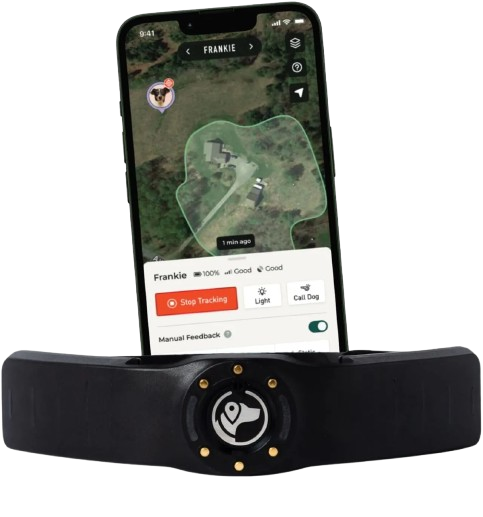
SpotOn Nova lets you create unlimited fences of any shape and size from the app, and the fencing works without a subscription. You can add keep-out zones, use the system off-grid, and reach a certified trainer for one-on-one help. SpotOn says its dual-band, dual-feed GPS holds the boundary accurately even under dense tree cover, and it points to independent testing for that claim.
Key specs
- Yard size: One-third acre and up, scaling to very large properties
- Fit: Dogs 15 lb and up, neck sizes 10–26 inches
- Battery: 33+ hours with tracking on, 40+ hours in extended mode
- Optional extras: A tracking plan adds live location, breach alerts and app-based manual feedback
Pros
- No subscription required for fences
- Unlimited fences and keep-out zones
- Built for tree cover and rugged terrain
- Free training support and a return window
Cons
- Higher upfront price than most options here
- Bulky for small dogs
- Live tracking and alerts require a paid plan
Skip it if your dog is under 15 pounds or you want a low-cost starter option.
2. Halo Collar 5: best training program
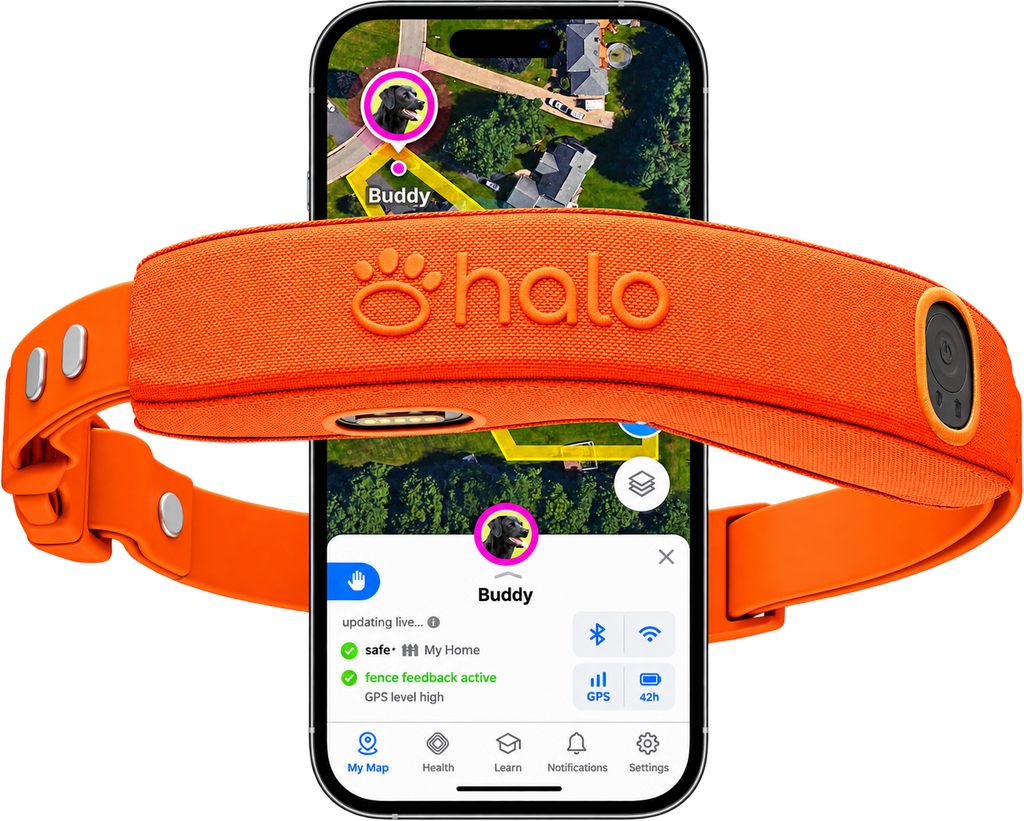
Halo Collar 5 pairs GPS fencing with a built-in training program designed by Cesar Millan, which helps first-time owners introduce the boundary step by step. It uses AlwaysOn GPS with location updates up to 20 times per second, and Halo says its ground-station corrections can place the collar within 2 feet of your dog’s real location.
Key specs
- Subscription: Required to activate GPS and fence features
- Feedback: Sound, vibration and optional static
- Connectivity: Wi-Fi, Bluetooth and cellular
- Extras: Activity reports and instant alerts when your dog nears or crosses a boundary
Pros
- Guided training inside the app
- Fast live tracking and instant boundary alerts
- Activity insights alongside fence data
Cons
- A membership is needed for the fence to work at all
- The collar is large for very small dogs
- Performance can dip in dense trees
Skip it if you don’t want a recurring fee.
3. Dogtra GPS Fence: best no-subscription value
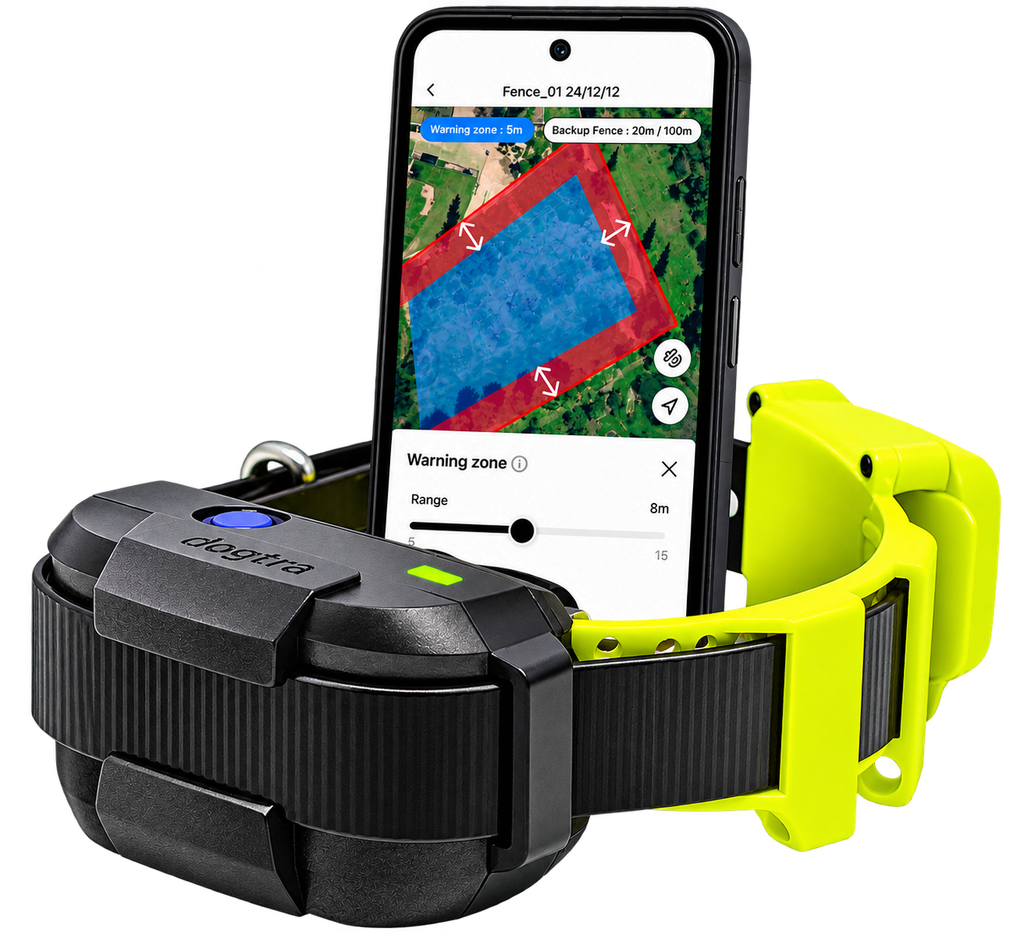
Dogtra GPS Fence is a containment-only collar with no monthly fees. You use the free app once to draw the fence, and after that the collar works on its own without your phone. Layered protection includes a warning zone, a primary fence and two backup fences. A return reminder tone guides the dog home, and corrections switch off when the dog is heading back inside.
Key specs
- Price: $199.99
- Yard size: Three-quarters of an acre or larger
- Fit: Dogs 15 lb and up, neck sizes 10–30 inches
- Build: IPX9K waterproof and rechargeable, with 100 adjustable levels
- Dogs: Up to three dogs can share a fence profile
Pros
- No subscription and the lowest cost on this list
- Works without the phone after setup
- Tone, vibration or static options for each boundary
Cons
- No live tracking or notifications
- Needs a large yard
- Training flags are sold separately
Skip it if you want to see your dog’s live location or your yard is under three-quarters of an acre.
Check Dogtra GPS Fence pricing
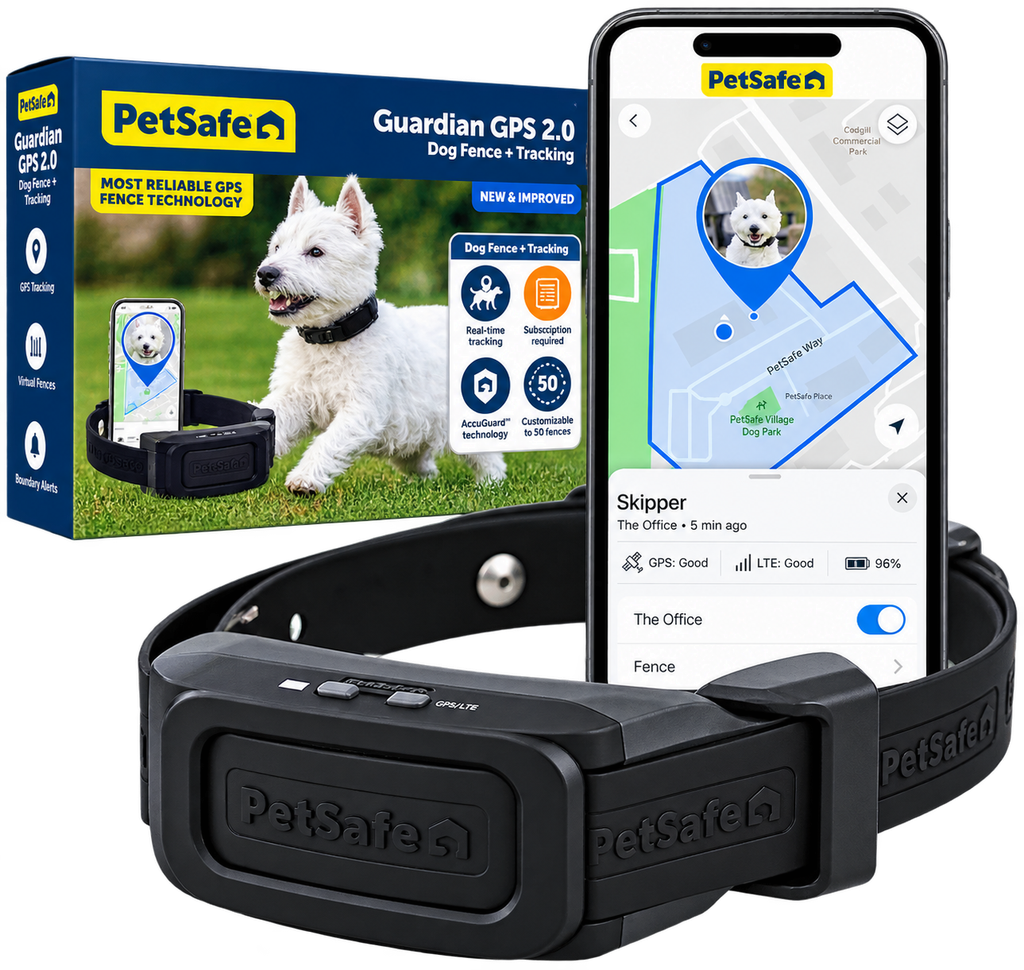
4. PetSafe Guardian GPS 2.0 Dog Fence + Tracking: longest battery life
Guardian GPS 2.0 offers the longest battery life in this guide, up to 70 hours, in a smaller and lighter collar than earlier PetSafe models. It uses dual-frequency GPS with AccuGuard technology, which combines GPS data with motion detection, and it stores up to 50 custom fences created in the MyPetSafe app.
Key specs
- Price: $449.99, plus a required plan (each dog needs its own collar and subscription)
- Yard size: Half an acre or larger
- Fit: Dogs 10 lb and up, neck sizes 8–28 inches
- Feedback: Tone, vibration and 10 levels of static
- Setup: A 2.4 GHz Wi-Fi connection is needed
Pros
- Up to 70 hours of battery
- Fits smaller dogs than SpotOn or Dogtra
- Up to 50 fences plus real-time tracking
Cons
- Higher upfront cost and a required subscription
- PetSafe advises other fence types for small or heavily wooded yards
Skip it if your yard is under half an acre or very wooded.
Check Guardian GPS 2.0 pricing
5. PetSafe Wireless Fence, 2 Dogs, Up to 1/2 Acre: simplest setup (not GPS)
This is not a GPS fence. A portable transmitter plugged in at home creates an adjustable circular boundary of up to half an acre, and the kit includes two collars and boundary flags. It sets up in a few hours with no digging, and your dog can return across the boundary without being corrected. We include it because many owners with smaller yards and two dogs are better served by a simple radio system than by a GPS collar.
Key specs
- Coverage: Circular, up to half an acre, expandable with an additional transmitter
- Fit: Waterproof collar, neck sizes 6–28 inches (the listing shows both 5 lb and 8 lb minimum weights)
- Battery: Collar battery lasts up to two months
- Portability: Works for camping or a vacation home if you have an outlet

Pros
- No subscription and easy setup
- Two collars included
- Works for smaller dogs and smaller yards
Cons
- Circular boundary only, with no custom shapes
- The transmitter needs a power outlet
- No GPS tracking or app map
Skip it if your property is irregular or you want live tracking.
Check PetSafe Wireless pricing
How to choose a GPS dog fence
Start with your yard
Minimum sizes differ: about one-third acre for SpotOn, half an acre for Guardian GPS 2.0, and three-quarters of an acre for Dogtra. On small yards, the warning and correction zones can get squeezed, which leaves too little room for the dog to learn. Dense trees are the hardest case, so lean toward brands that engineer for tree cover, and test the boundary on foot.
Match the collar to your dog
Check neck size and weight before anything else. Most GPS collars are bulky, and SpotOn and Dogtra are not designed for toy breeds. Guardian GPS 2.0 and PetSafe’s radio system list lower minimums. Also consider your dog’s temperament. A very anxious dog may need a gentler, slower introduction, and a vet or trainer can advise.
Decide whether you need live tracking
If you want to see where your dog is at any moment, choose SpotOn with its optional plan, Halo, or Guardian GPS 2.0. If you only need containment, Dogtra costs far less over time. Remember that tracking-only collars from brands like Tractive or Fi are trackers with escape alerts, not true fences, so they don’t replace a containment system.
Add up the total cost
Use the three-year table above. A collar with a lower sticker price and a required plan can cost more than a higher-priced one with no fees. Include extras like flags, straps and additional collars.
Think about multiple dogs
Dogtra lets up to three dogs share a fence profile, but each dog needs a collar. With Guardian GPS 2.0, each dog also needs its own subscription. PetSafe’s wireless kit includes two collars, which makes it the simplest two-dog option here.
Consider connectivity
Some collars need Wi-Fi only for setup, as with Guardian GPS 2.0 and its 2.4 GHz requirement. Others, like Dogtra, need only a Bluetooth-capable phone for setup and then work independently. Cellular-based tracking from Halo, SpotOn’s optional plan and PetSafe depends on coverage where you live. If you have weak cell service, SpotOn’s and Dogtra’s containment still works without it.
How to set up and train your dog on a GPS fence
Good training matters more than any feature on the spec sheet. The steps below reflect the common approach across brands.
- Charge the collar and update firmware. Dogtra specifically recommends keeping both the app and collar firmware current.
- Draw your fence. Choose an open area with a clear view of the sky, and leave room for the warning zone inside the boundary.
- Walk the boundary without your dog. Carry the collar along the line to see where it triggers. Adjust the fence if you see odd behavior near trees or buildings.
- Introduce flags. Many programs use physical flags along the boundary so the dog connects the cue with a visible line. Dogtra requires flag training and includes a guide, with flags sold separately.
- Start with tone and vibration. Let your dog learn the warning cue on a leash. Use treats and praise when the dog turns back.
- Practice in short sessions. SpotOn suggests about 15 minutes a day for most owners, and most dogs finish training within a couple of weeks.
- Add distractions gradually. Once your dog reliably responds, introduce distractions such as toys, people and other animals.
- Supervise at first. Stay outside with your dog until it consistently respects the boundary, and remove the collar when your dog is indoors.
SpotOn and Halo both include training guidance, and SpotOn offers one-on-one sessions with a certified trainer. If you’re struggling, a professional trainer can help.

Safety, ethics and limits
Some trainers and animal welfare groups discourage electronic stimulation. Most of the collars in this guide let you use tone and vibration only, and several make static correction optional. Start with the gentlest setting that works for your dog, and don’t increase levels without guidance. If your dog is anxious, very young, elderly or has a health condition, talk to your vet or a trainer before you begin.
Keep backup identification on your dog at all times. A GPS collar can run out of battery or lose signal. The ASPCA recommends both current ID tags and registered microchips.
Keep expectations realistic as well. A GPS fence guides behavior, but a dog with strong prey drive or intense distractions may still cross a boundary. Many owners combine GPS with supervision, a leash in unfamiliar areas, and, where appropriate, a physical fence.
Common mistakes to avoid
- Buying for the wrong yard. Ignoring a brand’s minimum acreage is the most common reason a GPS fence disappoints.
- Skipping training. The collar doesn’t contain a dog on its own. Rushing training leads to confusion and failure.
- Setting the fence on the property line. Leave room for the warning zone and for normal GPS drift, especially near roads.
- Ignoring total cost. Compare three-year costs, not sticker prices.
- Leaving the collar on indoors. GPS needs a sky view, so indoor use can trigger false corrections.
- Trusting accuracy claims blindly. Test the boundary in your own yard before relying on it.
The bottom line
The best GPS dog fence is the one that matches your property, your dog and your budget. SpotOn Nova is the strongest fit for large or wooded properties where you want no subscription for fencing. Halo Collar 5 suits owners who want live tracking and a guided training program and accept a membership. Dogtra GPS Fence delivers the lowest cost over time if you don’t need tracking and have at least three-quarters of an acre. PetSafe Guardian GPS 2.0 offers the longest battery life and fits smaller dogs, at a higher total cost. If your yard is small or you have two dogs, PetSafe’s radio wireless system may serve you better than GPS.
Whichever you choose, plan for training time, test the boundary yourself, keep ID tags and a microchip on your dog, and supervise while your dog learns.