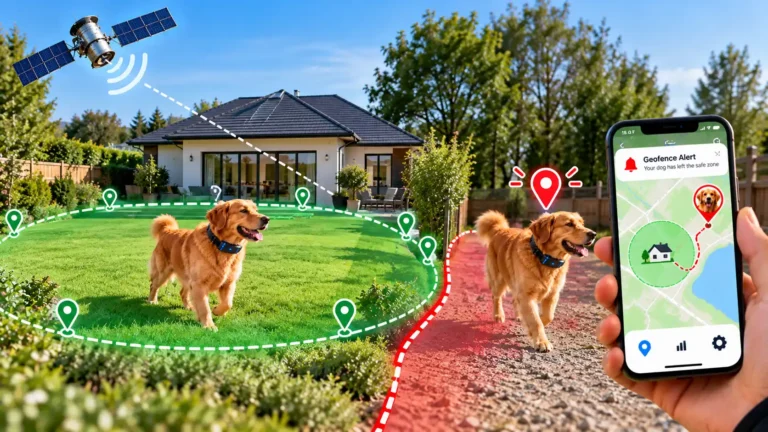
Dog trackers are electronic devices designed to help pet owners monitor their dogs’ locations and, in some cases, their activity and movement patterns. Depending on the technology used, a dog tracker may show a dog’s location on a smartphone map, help locate a nearby pet or guide an owner towards a dog using a compatible receiver.
Understanding what a dog tracker is, how it works and what its limitations are can help dog owners make informed decisions about pet safety. Although different tracking devices share a similar purpose, they do not all operate in the same way. Some use satellite positioning and mobile networks, while others rely on Bluetooth or radio signals.
This guide explains the meaning of a dog tracker, the technology behind it, the different types available, its main features, its benefits and limitations, and how tracking technology fits into responsible dog care.

1. What Is a Dog Tracker?
A dog tracker is an electronic tracking device or system designed to help determine the location of a dog. Many devices attach to a dog’s collar or harness, allowing owners to monitor the location of their pet using a compatible smartphone application, tracking receiver or connected system.
Dog trackers use different technologies to locate or detect a device. For example, a GPS tracker determines its position using satellite signals, while a Bluetooth tracker detects nearby compatible devices. Radio-frequency tracking systems can transmit signals to a dedicated receiver.
The information provided depends on the type of tracker. Some devices report location updates over a wider area, while others are intended for short-range finding. Certain advanced trackers also record activity, movement history or notifications when a dog leaves a designated area.
The main purpose of a dog tracker is to provide additional information about a dog’s whereabouts. It can support owners when monitoring pets during walks, outdoor activities or situations in which a dog might wander away.
What Is the Main Purpose of a Dog Tracker?
The primary purpose of a dog tracker is to help owners locate or monitor their dogs through an appropriate tracking system.
Depending on its features, a dog tracker may help owners:
- Check a dog’s current or last-known location.
- Locate a dog that has wandered away.
- Monitor movement during outdoor activities.
- Receive notifications when a dog crosses a virtual boundary.
- Review previous location information.
- Observe daily activity levels through compatible monitoring features.
Not every tracker supports all these functions. Understanding the underlying technology is essential to knowing what a particular device can actually do.
2. How Does a Dog Tracker Work?
A dog tracker works by using a specific technology to determine, detect or communicate the location of a tracking device. The process varies according to the system.
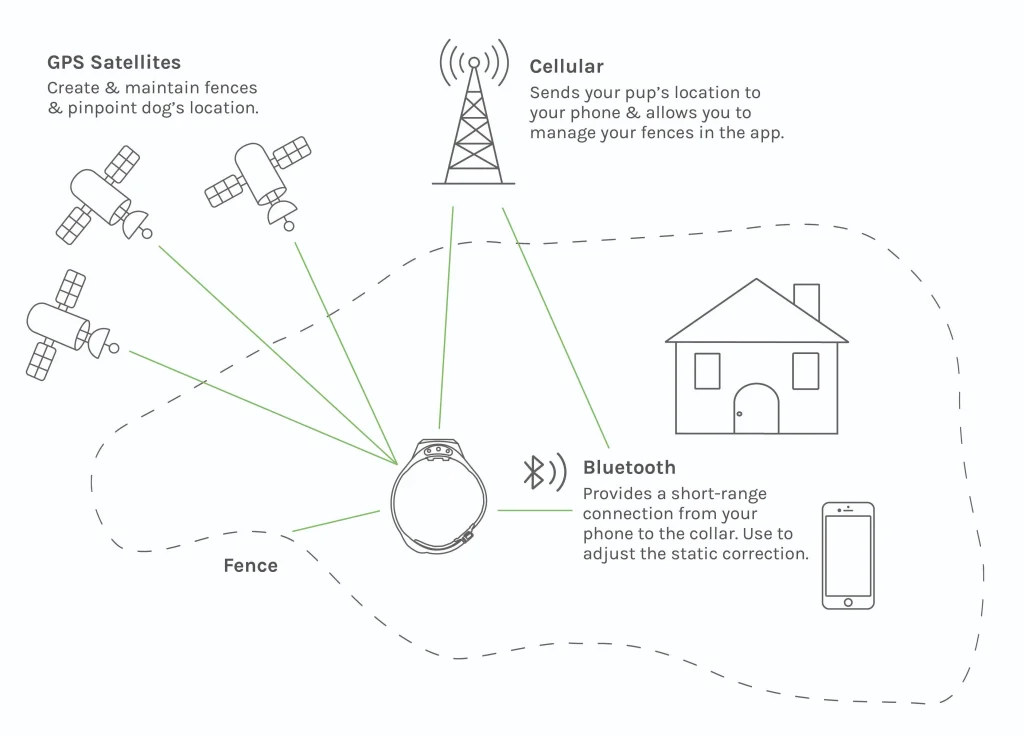
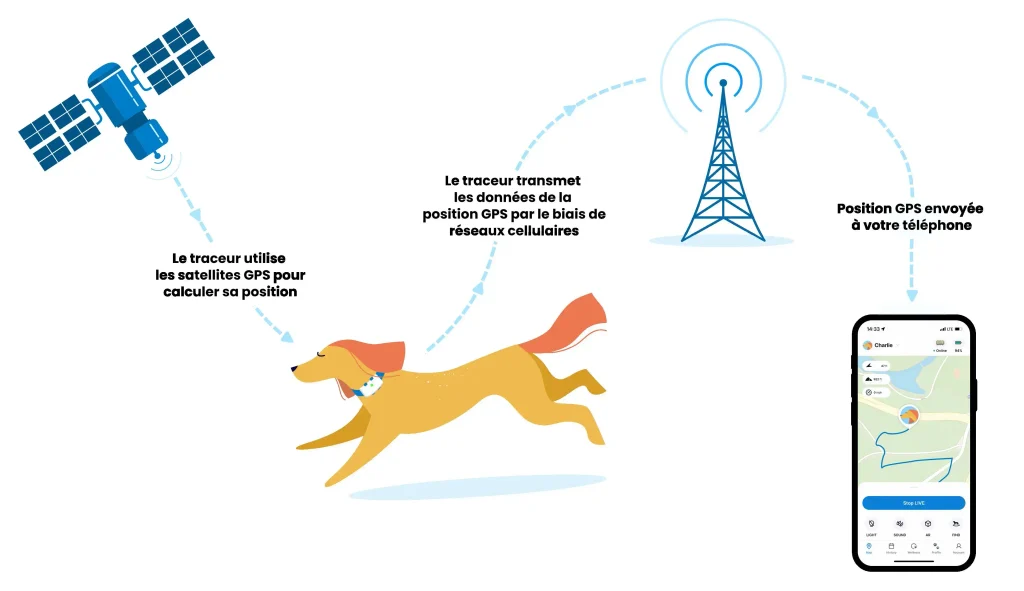
For example, a typical GPS dog tracker calculates its position using satellite signals and then transmits that information through a cellular network or another supported communication method. The owner can view the available location information through a connected application.
Other trackers operate differently. Bluetooth devices detect nearby signals, while radio-frequency systems communicate directly with compatible receivers.
2.1 GPS Technology
GPS stands for Global Positioning System. It is a satellite-based navigation system that allows compatible receivers to calculate their geographical position.
A GPS dog tracker receives signals from navigation satellites and uses the information to estimate its location. The device does not need to transmit its position to the satellites.
The calculated location can then be shared through another communication method, depending on the tracker’s design.
GPS positioning is useful for tracking over larger geographical areas, but its performance depends on environmental conditions. Dense buildings, heavy vegetation and limited visibility of the sky can affect location accuracy.
2.2 Cellular Connectivity
Many GPS dog trackers contain cellular communication technology that allows them to send location data to an online service or smartphone application.
The process typically involves three stages:
- The tracker calculates its location using satellite signals.
- The device transmits its location data through a supported mobile network.
- The tracking application displays the available information on a map.
This combination allows owners to view their dog’s location from a distance, provided the tracker has the necessary connectivity and service.
Cellular tracking may require a subscription or another form of mobile data service. Coverage also matters: if the tracker cannot communicate with a supported network, location updates may be delayed or unavailable.
2.3 Bluetooth Connectivity
Bluetooth is a short-range wireless communication technology used to exchange information between compatible devices.
Some pet-finding devices use Bluetooth to help owners locate a dog when the tracker is nearby. Other Bluetooth-based tags rely on a network of compatible phones or devices to report where a tag was last detected.
These systems are different from dedicated GPS trackers. A Bluetooth tag without its own satellite-positioning and remote communication capabilities cannot independently provide continuous GPS location updates.
Consequently, the location shown by a Bluetooth tracking system may be the last detected position rather than the dog’s current location.
2.4 Radio-Frequency Tracking
Radio-frequency (RF) tracking uses radio signals to communicate between a tracking device and a compatible receiver.
In some systems, a dog wears a transmitting collar while the owner carries a handheld receiver. The receiver detects the signal and may help the owner determine the direction or approximate distance of the dog.
Specialised radio tracking can be useful for working dogs and outdoor activities, particularly where cellular coverage is limited.
However, the practical range depends on the equipment, terrain, obstructions and radio conditions. Radio-frequency tracking should not be confused with GPS positioning, because the two technologies determine or communicate location in different ways.
2.5 How Does a Dog Tracker Show Location on a Phone?
A dog tracker can display location information on a smartphone when the device supports a compatible application and communication method.
In a typical cellular GPS system, the tracker calculates its position, sends the information to an online service and makes the data available through the application. The owner can then view the reported position on a digital map.
The frequency of updates varies between devices and settings. Some provide frequent updates, while others transmit information less often to conserve battery power.
It is also important to distinguish between a live location and a last-known location. A map may continue to display the most recent position even when the tracker is no longer transmitting new data.
3. What Are the Different Types of Dog Trackers?
Dog trackers can be divided into several categories according to their underlying technology and purpose. Understanding these differences helps explain why some devices work over long distances while others are suitable mainly for nearby finding.
3.1 GPS Dog Trackers
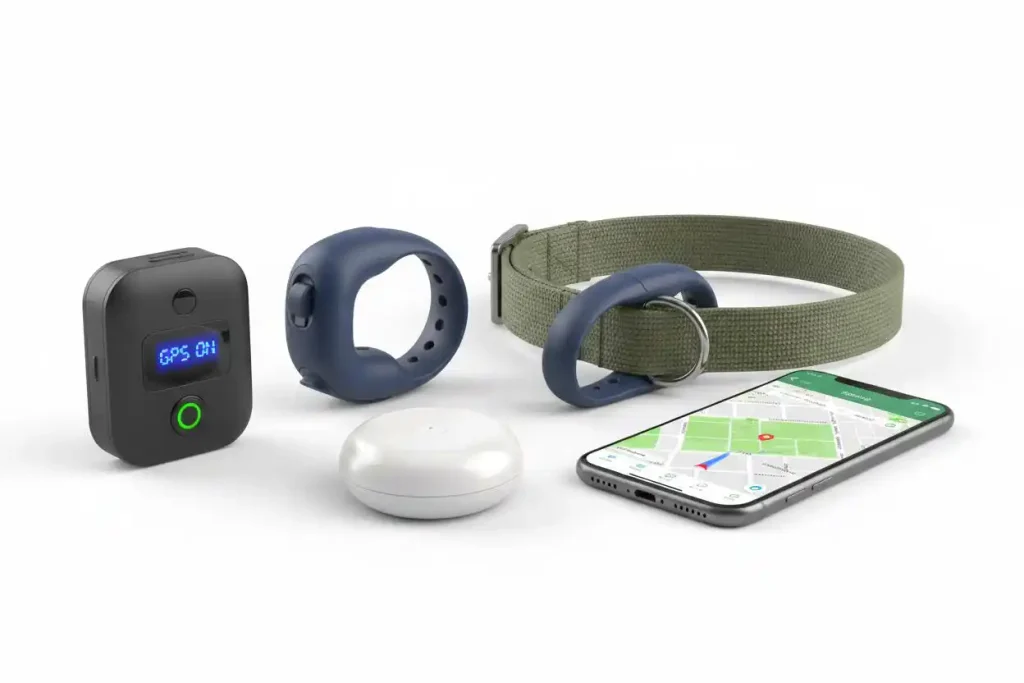
GPS dog trackers use satellite positioning to calculate their location. Many models also use cellular connectivity to send that information to a smartphone application.
Depending on the device, features may include location updates, location history, virtual boundaries and activity monitoring.
These trackers are commonly used to monitor dogs during walks, outdoor activities and situations in which an owner wants to check a pet’s location from a distance.
However, GPS positioning alone does not guarantee that a location will reach the owner’s phone. The device also needs a suitable communication method to transmit its information.
3.2 Bluetooth Dog Trackers
Bluetooth dog trackers use short-range wireless signals to detect nearby devices.
Some are designed for finding a pet when it is close to its owner. Others rely on compatible devices within a broader finding network to report a tag’s detected location.
Bluetooth tracking can be useful for nearby finding, but it has important limitations when a dog travels beyond the available detection range. Unless the system incorporates additional positioning and communication technologies, it cannot provide the same type of independent remote tracking as a cellular GPS device.
3.3 Radio-Frequency Dog Trackers
Radio-frequency trackers communicate with a compatible receiver through radio signals.
Some systems help the owner follow the direction of a transmitting collar, making them useful for specialised outdoor activities and certain working dogs.
Unlike cellular trackers, dedicated radio systems may communicate directly between the collar and receiver without relying on a mobile network. Their practical range and capabilities depend on the equipment and surrounding environment.
3.4 Smart Dog Collars and Activity Trackers
Smart dog collars and wearable tracking devices may combine several technologies in one product.
Depending on the model, they may provide location information alongside activity measurements, movement records, sleep estimates or other monitoring features.
It is important to distinguish location tracking from activity tracking. A device that counts steps or measures movement does not necessarily provide a reliable way to locate a dog over a distance.
Comparison of the Main Dog Tracking Technologies
| Feature | GPS with cellular connectivity | Bluetooth tracking | Radio-frequency tracking |
|---|---|---|---|
| Main function | Remote location monitoring | Nearby finding or network-assisted detection | Signal-based tracking |
| Typical range | Potentially wide, subject to coverage | Short-range direct detection; network-dependent beyond that | Depends on equipment and conditions |
| Smartphone location map | Commonly available | Depends on the system | Not always available |
| Mobile network | Generally required for remote cellular updates | Not necessarily required | Not necessarily required |
| Live location updates | Possible when the system is connected | Not guaranteed | Depends on the system |
| Common limitations | Coverage, battery and positioning conditions | Detection range and availability of nearby network devices | Terrain, obstructions and receiver range |
These categories describe general characteristics rather than every individual product. Some devices combine GPS, Bluetooth, cellular connectivity and other technologies.
4. What Features Can a Dog Tracker Provide?
The features of a dog tracker depend on its design, software and communication capabilities. Some devices provide basic location information, while others include additional monitoring and notification functions.
4.1 Location Monitoring
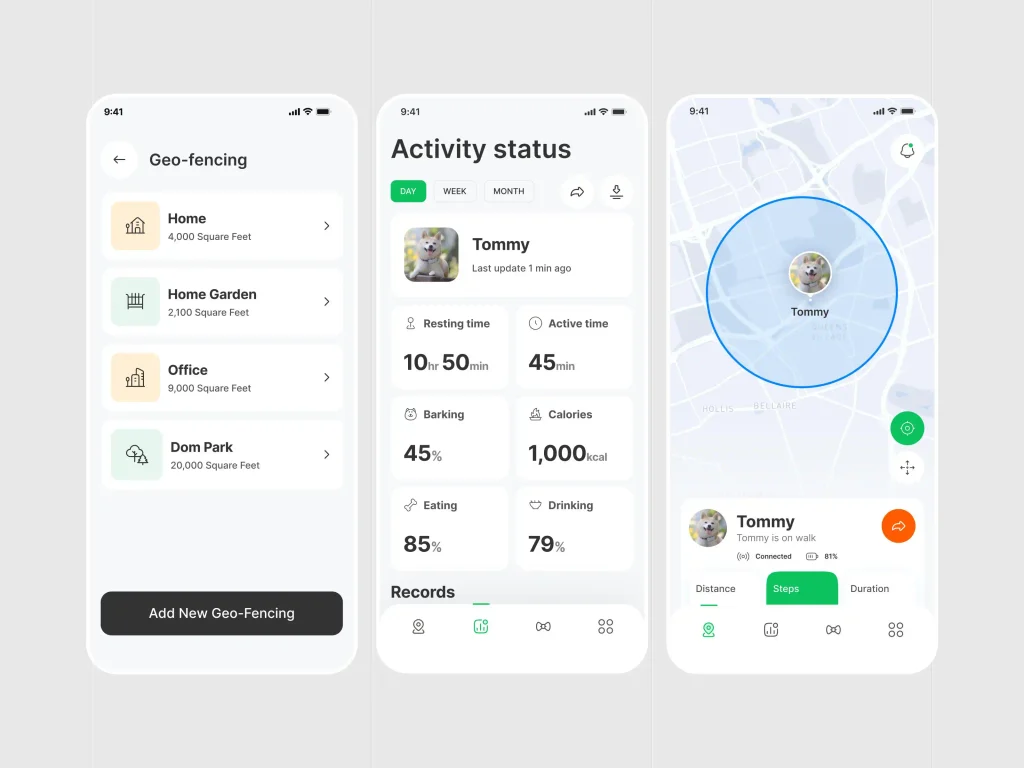
Location monitoring allows an owner to view the position reported by a compatible tracking device.
The information may be presented on a digital map and updated at intervals determined by the device. The reliability of the information depends on positioning accuracy, battery condition, connectivity and the tracker’s update settings.
4.2 Real-Time Tracking
Real-time tracking refers to receiving frequent location updates that allow an owner to follow a dog’s movements.
In practice, updates are not always instantaneous. Delays can occur because of weak signals, communication interruptions, power-saving settings or environmental conditions.
For this reason, real-time tracking should be understood as frequent location reporting rather than a guarantee of uninterrupted monitoring.
4.3 Geofencing and Safe-Zone Alerts
Geofencing is a feature that allows a user to establish a virtual boundary around a geographical area.
When a compatible tracker detects that the dog has crossed the configured boundary, the system may send an alert to the owner’s phone.
These notifications can provide additional awareness, but their effectiveness depends on location accuracy, communication availability and the settings configured in the application.
4.4 Location History
Some trackers record previous location information. This may help owners review where a dog has travelled during a particular period.
The length of time that information remains available depends on the device, application and service plan.
Location history is useful for understanding movement patterns, but it should not be interpreted as a complete or perfectly accurate record of every movement.
4.5 Activity Monitoring
Certain wearable devices measure activity indicators such as steps, movement duration or estimated activity levels.
These measurements may help owners observe changes in a dog’s routine. However, activity data is not a veterinary diagnosis, and consumer devices may not measure every behaviour accurately.
4.6 Battery and Connectivity Notifications
Some tracking systems display battery levels or notify owners when a device has a low charge or loses connectivity.
Such notifications can help users identify potential problems before relying on a tracker during an outdoor activity.
Not all devices provide these alerts, so their availability depends on the specific tracking system.
5. What Are the Benefits of Dog Trackers?
Dog trackers can provide useful information that supports responsible pet ownership. Their value depends on how well the tracking technology matches the owner’s circumstances.
5.1 Supporting the Search for a Lost Dog
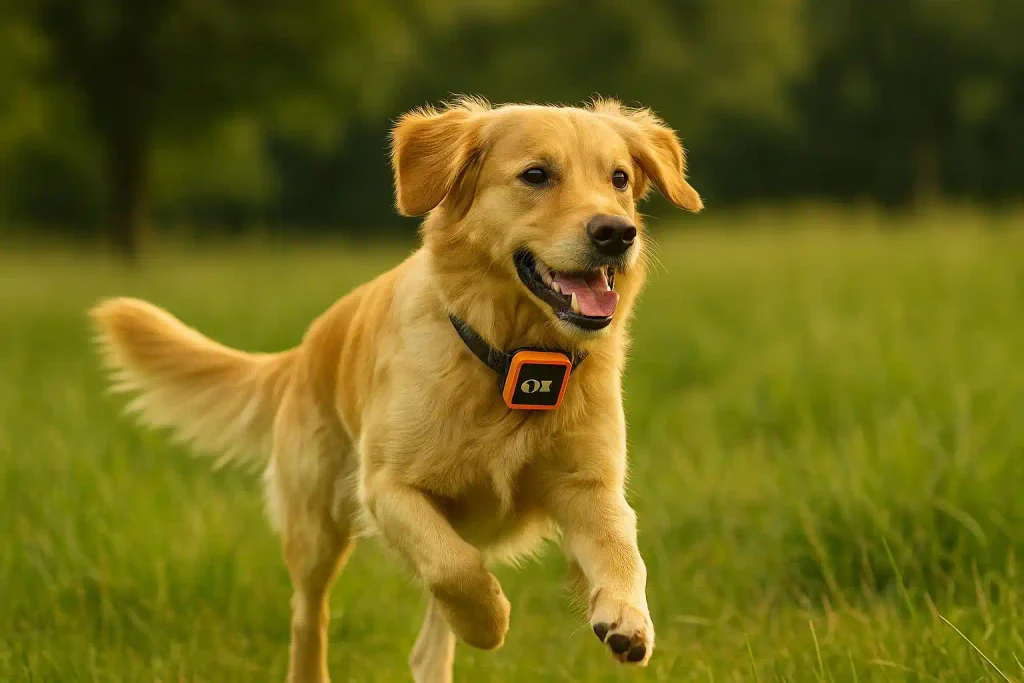
A working tracker may help an owner identify a dog’s reported location after it wanders away.
Location information can make a search more focused than relying entirely on visual searching or calling the dog’s name.
However, a tracker cannot guarantee recovery. The device may lose connectivity, run out of battery or report an outdated position.
5.2 Greater Awareness During Outdoor Activities
Dogs may explore unfamiliar surroundings during walks, hiking trips or countryside visits.
A tracking system can provide additional information about a dog’s location, depending on the environment and technology being used.
It is still important to supervise dogs appropriately and follow local rules about leads and off-lead areas.
5.3 Understanding Movement Patterns
Trackers that record location history or activity data may help owners understand how a dog moves throughout the day.
For example, activity records may reveal changes in routine, while location history may show commonly visited areas.
Such information can be useful for general observation, but significant changes in behaviour or activity should be discussed with a veterinary professional when appropriate.
5.4 Additional Awareness of Boundary Crossings
Geofence alerts may notify owners when a dog moves beyond a defined area.
This can be helpful when monitoring a pet around a home or another familiar location. Nevertheless, an alert is not a physical barrier and does not prevent a dog from leaving the area.
5.5 Supporting Responsible Pet Care
Tracking technology can complement other pet-safety measures by giving owners another source of information.
Its greatest value comes from using it alongside appropriate supervision, secure identification, safe handling and good training practices.
6. What Are the Limitations of Dog Trackers?
Understanding the limitations of tracking devices is as important as understanding their features.
6.1 Location Accuracy Can Vary
GPS positioning depends on receiving suitable satellite signals. Buildings, dense vegetation, steep terrain and other obstructions can reduce accuracy.
A displayed location should therefore be treated as an estimate rather than a guarantee of the dog’s exact position.
6.2 Connectivity Is Not Always Available
Cellular GPS trackers generally need a compatible network to transmit remote location updates.
In areas with poor coverage, information may become delayed or unavailable. Dedicated radio systems have different limitations, including receiver range and signal obstruction.
6.3 Batteries Need Regular Charging
Most electronic trackers depend on a battery.
Frequent location updates, continuous communication and certain monitoring functions can increase power consumption. Battery life varies according to the device, settings, temperature and usage.
A tracker that has lost power cannot provide ongoing electronic tracking.
6.4 Subscription Requirements May Apply
Some cellular trackers require an active subscription to transmit location data through their associated service.
Other systems may operate without a recurring fee. Costs and service requirements depend on the technology and provider.
6.5 A Tracker Does Not Prevent Escaping
A tracking device reports or helps locate a dog; it does not stop the animal from escaping, entering traffic or encountering other hazards.
Secure gates, suitable leads, supervision and training remain essential elements of dog safety.
6.6 Tracking Information May Be Incomplete
Location updates may be delayed, interrupted or inaccurate. Some systems display a last-known position when a new location is unavailable.
Owners should check the timestamp and connection status of the reported location instead of assuming that every map position is current.
7. Are Dog Trackers Safe for Dogs?
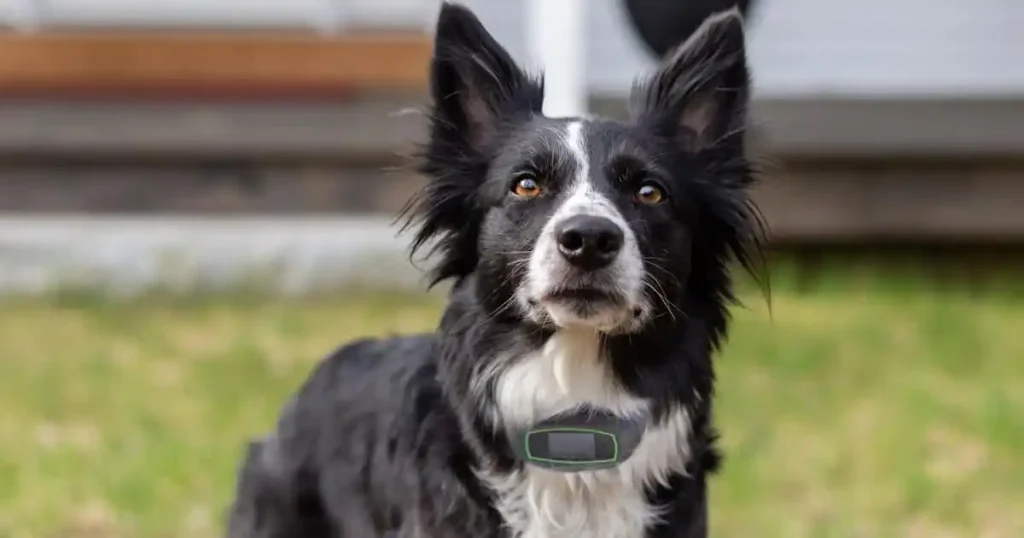
Dog trackers are generally designed to be worn by animals, but safe use depends on choosing an appropriate device and fitting it correctly.
7.1 Weight and Comfort
The size and weight of a tracker should be suitable for the dog wearing it.
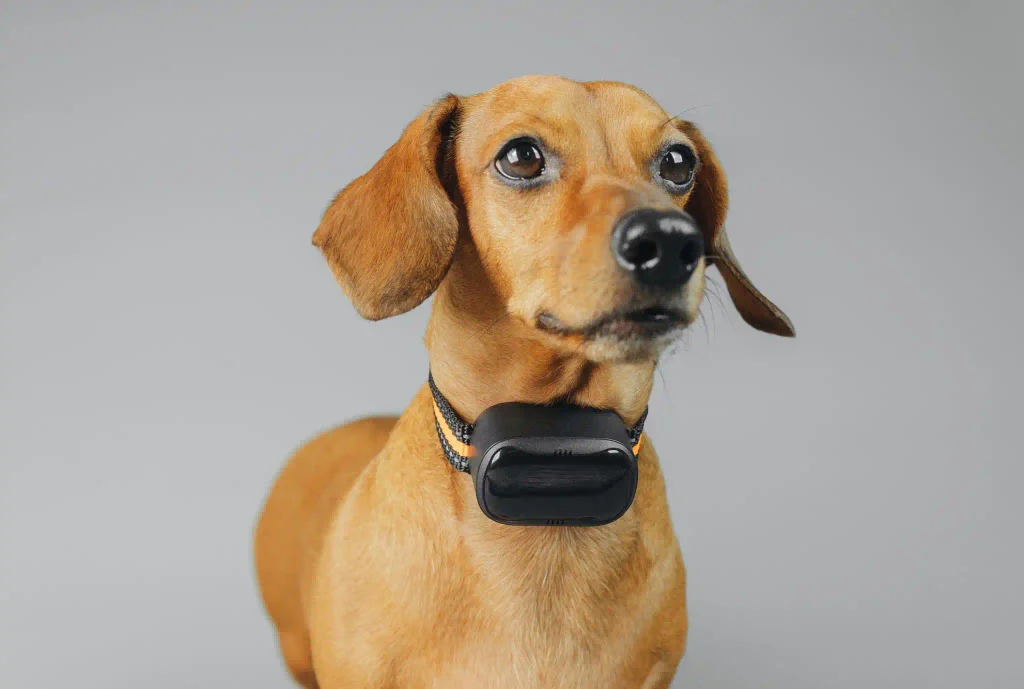
A device that is too heavy or bulky may be uncomfortable, particularly for small dogs. The attachment should not restrict movement or interfere with normal collar or harness use.
7.2 Correct Fitting
The tracker should be attached according to the manufacturer’s instructions. Owners should check that the device is secure and that the collar or harness fits properly.
Regularly inspect the attachment for damage, loose parts or signs of rubbing and skin irritation.
7.3 Water Resistance
Water resistance differs between devices. A tracker described as water-resistant may not be suitable for swimming or prolonged immersion.
Check the manufacturer’s stated rating and usage instructions before allowing a dog to wear the device in wet conditions.
7.4 Electronic Signals and Device Maintenance
Tracking devices may use GPS receivers, Bluetooth, cellular communication or radio-frequency transmission.
A published scientific review of pet-tracking devices assessed radio-frequency exposure and reported that the evaluated exposures were below the international reference levels considered in the study. This is reassuring for the devices and conditions assessed, but it should not be interpreted as proof that every device or use condition has been individually evaluated.
Owners should follow manufacturer instructions and seek veterinary advice if a device causes discomfort or skin problems.
8. What Is the Difference Between a Dog Tracker and a Microchip?
A dog tracker and a microchip serve different purposes.
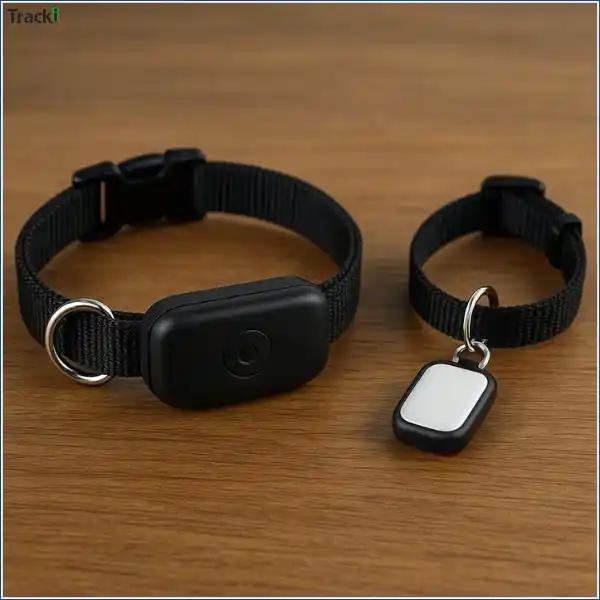
A dog tracker is an electronic device that helps determine or communicate a dog’s location through its supported tracking technology.
A standard pet identification microchip is a small implanted identification device that can be read using a compatible scanner. The microchip provides an identification number associated with the animal’s registered details; it does not independently transmit GPS coordinates or provide live location tracking.
The two approaches complement one another.
A tracker may help an owner locate a dog, while a microchip can help identify the animal if it is found and scanned by a veterinary practice, animal shelter or other appropriate organisation.
A collar identification tag can also provide useful contact information. Local microchipping and identification requirements vary, so owners should follow the rules applicable to their location.
9. How Should a Dog Tracker Be Used in Everyday Life?
Using a dog tracker responsibly involves more than attaching a device to a collar. Owners should understand its functions, check its condition and recognise when the information may be unreliable.
9.1 Understand the Tracking Technology
Before using a tracker, determine whether it relies on GPS, cellular networks, Bluetooth, radio signals or a combination of technologies.
This helps establish what information the device can provide and where its limitations are likely to appear.
9.2 Check the Battery
Charge the device according to the manufacturer’s instructions. Check the battery before walks, journeys and outdoor activities, particularly if the tracker has not been used recently.
9.3 Test the Location Function
Test the tracking system in a familiar environment to understand how location updates appear in the application or receiver.
Check whether the location is updating and whether notifications work as expected.
9.4 Review Connectivity
Check the device’s connection status and confirm that the required mobile service or compatible receiver is available.
If travelling to an unfamiliar area, remember that coverage may differ from the conditions at home.
9.5 Keep Identification Up to Date
Make sure the dog’s identification details and microchip registration information are current, where applicable.
A tracker should form part of a broader safety approach rather than being the only method used to identify or locate a pet.
9.6 Continue Supervising Your Dog
Tracking technology is an additional monitoring tool, not a replacement for responsible supervision.
Owners should continue using secure equipment, suitable training and appropriate precautions for the dog’s surroundings.
10. Frequently Asked Questions About Dog Trackers
Conclusion
A dog tracker is an electronic device or system that helps owners monitor a dog’s location or detect its movements through different tracking technologies. GPS, cellular, Bluetooth and radio-frequency systems each offer distinct capabilities, and understanding these differences is essential to interpreting the information they provide.
Some trackers support remote location monitoring, while others are intended for nearby finding or specialised outdoor tracking. Additional features may include location history, boundary alerts and activity measurements, but these functions vary between devices.
Dog trackers can support responsible pet care by providing additional information about a dog’s whereabouts. Nevertheless, their effectiveness depends on technology, connectivity, battery power, positioning conditions and correct use.
Most importantly, tracking technology should complement, rather than replace, proper identification, supervision, training and safe handling. Understanding what a dog tracker can and cannot do allows owners to use this technology with realistic expectations and a stronger awareness of pet safety.