What Does Last-Known Location Mean on a GPS Dog Tracker?
When your dog’s tracking app displays a last-known location, it is showing a position associated with the most recent location information available to the app. That position may be old. Understanding the label and its timestamp helps you avoid assuming your dog is still at the marked spot.

If you have searched your dog’s map and wondered, “Does last-known location mean my dog is still there?” the answer is no. It generally means the app is displaying a previously recorded or reported position because a newer one is not currently available or has not yet replaced it.
The exact meaning of the label depends on the tracker and its app. Some products distinguish the time a position was obtained from the time it was transmitted or displayed. Check the manufacturer’s documentation before interpreting a particular status message.
Quick answer: What does last-known location mean?
A last-known location on a GPS dog tracker is the most recent location information available to the tracking app or system. It may represent where the tracker was when it last recorded or successfully reported a position. It does not prove that the dog remains at that location.
- Check the location timestamp.
- Look at the tracker’s current status.
- Consider whether the dog may have moved since the recorded position.
- Do not rely on a stale map pin as the dog’s confirmed current location.
1. Definition of Last-Known Location

A last-known location is the most recent position that the app can show based on the information it has received or stored. Depending on the product, it may be associated with the last successful location report, the last recorded GPS fix, or another manufacturer-defined event.
The important distinction is that the label describes available location information. It does not establish that the tracker is currently at that point or that your dog has not moved.
Why the label matters
A location marker can remain visible on a map even when the app cannot display a newer position. That marker is useful as a reference point, but its value depends on when the location was recorded and what happened afterward.
2. Why a Tracker May Show an Older Position

A tracker may show an older position when a new location has not been obtained, transmitted, or made available in the app. The reasons vary by device, and the label alone does not identify which part of the process has been interrupted.
The tracker may also use scheduled reporting or a power-saving mode that does not produce a continuous stream of positions. Some products update less frequently under certain conditions.
Common reasons for a stale location
- The latest location report has not reached the app.
- The tracker has not obtained a new usable position.
- The device is using a scheduled or power-saving reporting mode.
- The app is displaying a previously stored location.
- The tracking system has not yet replaced the old position with a new report.
These are possible explanations, not a diagnosis. The status messages and documentation for your specific tracker determine what can be inferred.
3. How to Read the Timestamp

The timestamp is one of the most useful details when interpreting a last-known location. Look for wording such as Last updated, Last seen, Location recorded, or Last connected.
These labels may refer to different events. For example, the time a tracker recorded a position may differ from the time that position was transmitted or displayed in the app.
Example: How old can a GPS dog location be?
There is no universal age limit for a last-known location. A tracker may display a position from minutes or much longer ago, depending on the device, the information available to the app, and how the manufacturer handles historical locations.
| Example display | What it tells you | What it does not prove |
|---|---|---|
| Updated moments ago | The app reports a recent update according to its timestamp. | That the position is perfectly accurate. |
| Updated 20 minutes ago | The displayed location may be 20 minutes old. | That the dog is still at that point. |
| Last seen yesterday | The available location information may be substantially outdated. | That the tracker has remained at the same place since yesterday. |
| No timestamp shown | The app has not made the time clear in the visible display. | That the location is current. |
Questions to ask when reading the time
- Does the timestamp advance when the app receives new information?
- Does the app distinguish the last GPS fix from the last network report?
- Is the displayed time in your local time zone?
- Does the app indicate whether the tracker is currently online?
4. Last-Known Location vs. Current Location

A last-known location and a current location are not necessarily the same. A last-known location refers to the latest position available in the system. A current location usually means a more recent position reported by the tracker, according to that product’s update and status definitions.
Even a fresh position is an estimate rather than a guarantee of exact coordinates. GPS.gov explains that positioning performance depends on signal conditions, satellite geometry, and receiver design.
| Feature | Last-known location | Current or recent location |
|---|---|---|
| Meaning | Most recent position information available to the app or system | A position reported recently according to the app’s status |
| Timestamp | May be old | Should reflect a recent report if the status is accurate |
| Does it confirm where the dog is now? | No | Not with absolute certainty |
| Can the pin be inaccurate? | Yes | Yes |
| Best next step | Check the timestamp and whether newer data is available | Interpret the position alongside its accuracy indicator and conditions |
The distinction is especially important when a dog is missing. An old position may help identify where to begin searching, but it should not be treated as confirmation that the dog remains there.
5. What to Check if the Location Is Stale

If the timestamp has not advanced, focus on what the app is actually reporting. Check the tracker status and consult the manufacturer’s documentation to understand the status label.
You do not need to perform every possible network troubleshooting step simply because the app says “last-known location.” Start with the timestamp and the status information available to you.
A simple interpretation checklist
- Read the exact timestamp associated with the location.
- Check whether the tracker is marked online, offline, or connecting.
- Look for a newer location in the map or location history.
- Check the help documentation for the meaning of the status label.
- If no new location is being reported, follow the dedicated no-update guide.
If the timestamp is fresh but the position itself seems incorrect, see the separate guide: Why Is My GPS Dog Tracker Showing the Wrong Location? This companion article focuses on position markers that appear inaccurate rather than stale.
6. Why the Dog May Have Moved

Dogs do not remain still just because a map pin does. They may continue walking, run into another part of a yard, follow a scent, or leave the area after the last location was recorded.
If the tracker has not supplied a newer position, the app may continue to display the earlier one. This is why a last-known location should be treated as a reference point rather than a reliable statement about the dog’s present position.
How to interpret the map responsibly
- Consider the age of the last location report.
- Do not assume the dog has stayed in one place since that report.
- Use the position as one clue alongside other available information.
- If the dog is missing, start a physical search rather than waiting for the app to refresh.
7. Frequently Asked Questions
1. What does last-known location mean on a GPS dog tracker?
It generally means the most recent location information available to the app or tracking system. Depending on the product, it may refer to the last recorded position or the last position successfully reported. Check the app’s timestamp and status definitions for the exact meaning.
2. Does last-known location mean my dog is still there?
No. It identifies a previously recorded or reported position. Your dog may have moved since then. Check the timestamp and do not treat a stale location as confirmation of the dog’s current whereabouts.
3. How old can a GPS dog location be?
There is no universal age limit. A tracker may show an old position for minutes or longer, depending on the device and the information available to the app. The timestamp is the best starting point for interpreting the location’s age.
4. Why does my dog tracker show the last location instead of a new one?
The app may not have received a newer position, the tracker may not have recorded a new fix, or the device may use scheduled reporting. The label alone does not identify which explanation applies. Check the tracker status and manufacturer’s guidance.
5. Is last-known location the same as live tracking?
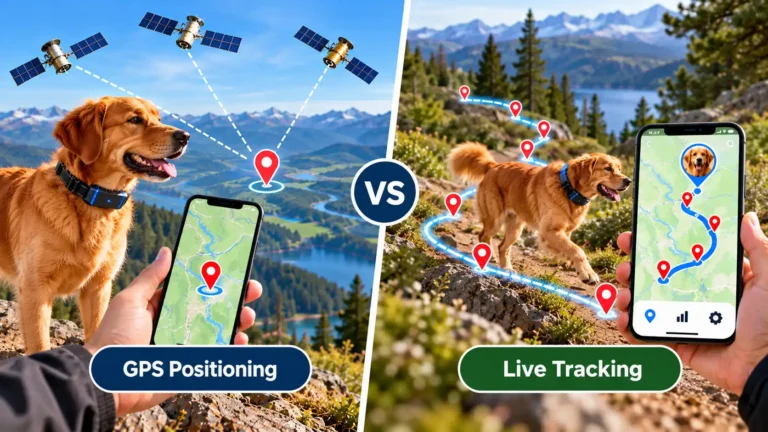
No. Last-known location refers to the most recent position information available. Live tracking is a mode intended to provide more frequent updates, but its behavior and limitations vary by device and signal conditions.
6. What does the timestamp on a dog tracker mean?
It indicates the time associated with a location or status event, but the exact event depends on the app. It may be the time the location was recorded, reported, or last updated. Consult the manufacturer’s documentation if the label is unclear.
7. Can a last-known location be inaccurate?
Yes. The recorded position may have been affected by satellite reception, environmental obstacles, receiver limitations, or map data. In addition, the position may be old. Location age and location accuracy are two separate questions.
8. Should I travel to the last-known location if my dog is missing?
It may be a useful starting point, but first consider the timestamp and how much time has passed. Do not assume the dog is still there. Start searching promptly and contact local shelters or animal control as appropriate.
9. What is the difference between last-known location and wrong location?
Last-known location describes which position is available to the app. A wrong location describes a position that does not accurately represent the tracker’s actual location. A last-known position can also be inaccurate, but the two terms describe different issues.
Read our separate guide: Why Is My GPS Dog Tracker Showing the Wrong Location? Verify the URL before publishing.
10. What should I do if the last-known location never changes?
Check the timestamp and the tracker status. If no new locations are being reported, use the dedicated troubleshooting guide for missing updates and follow the manufacturer’s instructions for your exact model.
Read the GPS dog tracker not-updating guide. Confirm that the URL matches your published article.
Final Thoughts: Treat Last-Known Location as a Reference Point
A last-known location on a GPS dog tracker tells you the most recent location information available to the app or tracking system. It does not prove that your dog remains at that point.
Check the timestamp, understand the status label, and consider whether the dog could have moved since the position was recorded. Remember that location age and location accuracy are different issues and may require different troubleshooting steps.
If your dog is missing, begin searching immediately instead of relying on a stale map marker. Use the last-known location as one piece of information alongside other appropriate recovery steps.
Editorial note: Status labels and reporting behavior vary by tracker. Consult the current documentation for your particular device.