GPS Dog Tracker vs. Microchip: What Is the Difference?
A GPS dog tracker can help you locate your dog’s reported position. A microchip helps identify your dog if someone finds them. Although both support pet safety, they work in very different ways.
Explore their differences, benefits, limitations and how using both can strengthen your dog’s safety plan.

1. What Is a GPS Dog Tracker?

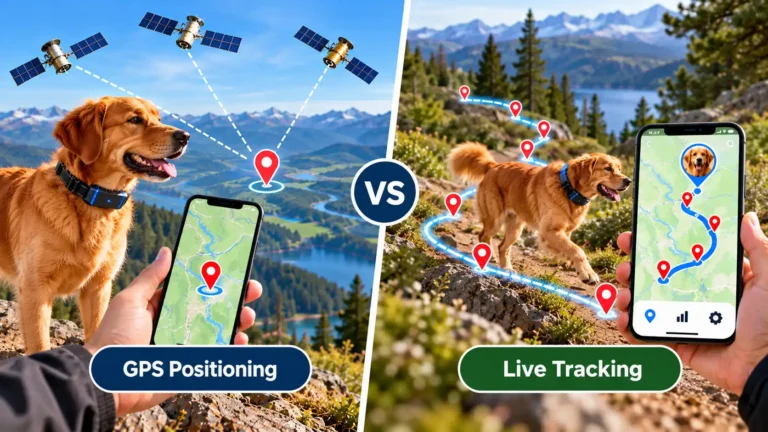
A GPS dog tracker is a device that usually attaches to a dog’s collar or harness. It uses signals from navigation satellites to estimate its position. Many consumer trackers then send that information to an app using a cellular connection.
Common GPS dog tracker features
- Location reporting on a smartphone map.
- More frequent updates through a live-tracking mode on supported models.
- Location history or route information on selected devices.
- Virtual safe-zone alerts, often called geofencing.
- Battery notifications and activity features on some models.
Features vary by manufacturer and model. Some trackers need a subscription for cellular connectivity or particular app features. Check the product’s supported regions, service requirements and specifications before buying.
2. What Is a Dog Microchip?

A standard pet microchip is a tiny electronic identification device implanted under the skin by a trained professional. It contains a unique identification number that can be read using a compatible scanner.
The number can be checked against a pet recovery registry to help identify the owner. The registry record needs to be registered correctly and kept up to date for this process to work effectively.
What a microchip can and cannot do
- Provides a long-term form of identification.
- Can help a veterinary clinic or shelter contact an owner after finding a dog.
- Does not need a rechargeable battery or cellular service.
- Does not show a dog’s live location or movement history.
- Must be read with a compatible scanner.
A microchip is not a GPS device. It does not independently communicate with your phone or reveal where your dog is. Registration and current contact details are essential.
3. How Do GPS Trackers and Microchips Work?

Reports the device’s position
The tracker calculates an estimated position from satellite signals. A communication system, commonly cellular data, delivers that position to the owner’s app.
The displayed position may be delayed or approximate, depending on reception, coverage, settings and the device.

Provides identification after discovery
A compatible scanner activates the passive chip and reads its unique identification number. A registry search can then help the finder contact the owner.
The microchip does not transmit a location or provide a live tracking feed.
4. GPS Dog Tracker vs. Microchip: Key Differences
Compare the main features before deciding what your dog needs.
| Feature | GPS Dog Tracker | Microchip |
|---|---|---|
| Main purpose | Reports a device’s location | Identifies a dog after it is found and scanned |
| Technology | Satellite positioning plus a communication method, often cellular | Passive electronic identification read by a scanner |
| Live location | Available on many models, subject to service conditions | Not available |
| Map display | Usually available through a compatible app | No map or location display |
| Battery | Normally requires charging | Standard passive chips do not need a battery |
| Cellular connection | Often required for wide-area app updates | Not required |
| Scanner required | Usually not for app-based location | Yes, a compatible scanner is needed |
| Can become detached? | Yes, if the collar device comes off | Implanted under the skin and normally stays in place |
| Recurring costs | A subscription may be required | Usually no GPS tracking subscription; registry terms vary |
| Best use | Finding and monitoring a dog’s reported location | Permanent identification and owner contact |
5. Benefits and Limitations of Each Option

GPS tracker benefits
- May help you search using the latest reported location.
- Can provide updates when a dog moves away from home.
- May include location history and safe-zone alerts.
GPS tracker limitations
- Requires power and regular maintenance.
- May depend on cellular coverage and a subscription.
- Can be lost or damaged.
- Cannot guarantee recovery of a missing dog.

Microchip benefits
- Provides long-term identification.
- Does not require charging or cellular service.
- Cannot fall off like a collar-mounted device.
Microchip limitations
- Cannot locate a missing dog.
- Requires a compatible scanner.
- Depends on correct, current registry information.
A visible identification tag is useful too. Someone who finds your dog may be able to call you immediately, without needing access to a scanner or registry.
6. Why Using Both Can Be a Better Safety Plan

A GPS tracker and microchip address different risks. The tracker may help you find your dog’s reported location, while the microchip offers a way to identify your dog if the collar or tracker is lost.
- If your dog escapes: A working GPS tracker may provide a useful location to guide your search.
- If the collar comes off: The microchip remains a method of identification.
- If a shelter finds your dog: Staff can scan the microchip and use the registry details to try to contact you.
- If the tracker stops reporting: The microchip still provides identification, although it cannot show where the dog is.
Neither device guarantees recovery. Use both alongside secure equipment, visible identification, current registry details and responsible supervision.
7. How to Make Sure Your Dog’s Microchip Can Help

- Register the chip: Make sure its number is linked to an appropriate pet recovery registry.
- Update your contact details: Change your phone number, email or address when needed.
- Keep the number accessible: Store the chip number and registry details safely.
- Ask your veterinarian to scan it: Confirm that the chip can be detected and read during routine care.
- Use a visible ID tag: Include current contact details on your dog’s collar where appropriate.
- Check local requirements: Microchipping and registration rules differ between locations.
For further guidance, read the American Veterinary Medical Association’s microchipping FAQ.
8. What to Check Before Buying a GPS Dog Tracker

Technical features
- Supported coverage in your area.
- Communication method and update frequency.
- Battery life and charging time.
- Location history and alerts.

Practical considerations
- Device weight and fit for your dog.
- Water-resistance rating.
- Subscription and renewal terms.
- App compatibility and warranty.
Test the tracker before relying on it. Learn how the app displays an old location, what happens when coverage is lost, and how the device alerts you when its battery is running low.
Frequently Asked Questions
1. Can a microchip track my dog in real time?
No. A standard pet microchip provides an identification number that can be read by a compatible scanner. It does not provide GPS location or live tracking.
2. Is a GPS tracker better than a microchip?
They serve different purposes. A GPS tracker may help locate a dog’s reported position, while a microchip helps identify the dog after it is found and scanned.
3. Does a microchip need charging?
No. A standard passive identification microchip does not have a battery that needs charging.
4. Can a GPS tracker replace a microchip?
No. A tracker can become detached, run out of power or lose connectivity. A microchip provides a separate, long-term identification method.
5. Does a microchip need a subscription?
The chip itself does not require a GPS tracking subscription. Registry terms vary, so check whether your chosen registry charges for particular services.
6. Can a shelter find my details from a microchip?
A shelter or veterinary clinic can scan a readable chip and use its number to search an appropriate registry. Current registration and contact information help the process.
7. Can my dog have both a microchip and a GPS tracker?
Yes. The microchip provides identification, and the GPS tracker may report location through an app. They can be used together.
8. Should a microchipped dog still wear an ID tag?
Yes. A visible tag allows a finder to contact you directly without needing to scan the microchip first.
9. Does microchipping prevent a dog from getting lost?
No. A microchip helps identify a dog after it is found. It does not prevent escapes or reveal the dog’s location.
10. What is the safest approach?
Use a combination of suitable identification, current microchip registration, secure equipment, responsible supervision and a GPS tracker if wide-area location reporting is useful for your dog.
Sources and Further Reading
- American Veterinary Medical Association: Microchipping Animals FAQ
- American Animal Hospital Association: Pet Microchipping FAQs
This article provides general educational information. Check the manufacturer’s documentation for exact GPS tracker capabilities and consult a veterinarian about microchipping questions.