GPS Dog Tracker vs. Bluetooth Tracker: What Is the Difference?
GPS and Bluetooth trackers can both help you locate things attached to your dog, but they use different technologies and serve different purposes. Understanding their range, connectivity, costs and limitations can help you choose a more suitable option for your pet.
In this guide, discover how each tracker works, when it is useful, and why a Bluetooth tag should not automatically be treated as a replacement for a dedicated GPS pet tracker.

1. How Do GPS and Bluetooth Dog Trackers Work?
The main difference is how each device obtains or communicates location information. Some products combine multiple technologies, so check the manufacturer’s specifications rather than relying on the product name alone.

Satellite positioning with a communication link
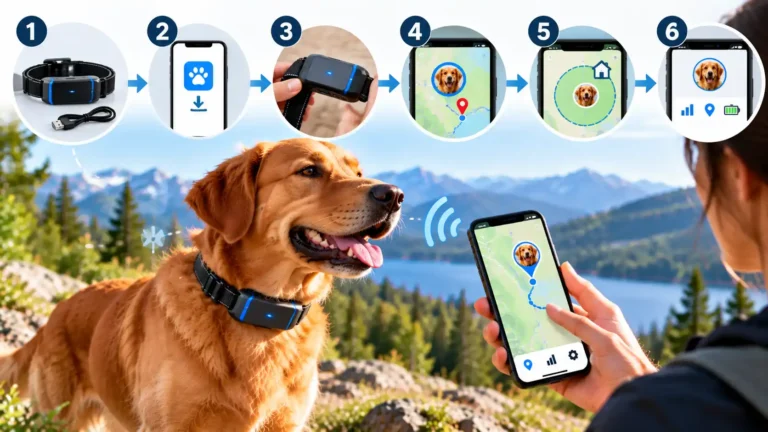
A GPS-enabled pet tracker receives signals from navigation satellites to estimate its position. Many consumer dog trackers then use a cellular connection to send that position to a companion app.
Where the device has a usable satellite view and supported network coverage, the app may provide updated locations, movement history, safe-zone alerts or other features, depending on the model and plan.

Short-range signals and nearby devices
A standard Bluetooth tag broadcasts a wireless signal that a compatible nearby phone or device can detect. It generally does not calculate its own satellite-based GPS position.
Some Bluetooth tags also use a crowd-finding network. When a compatible participating device detects the tag, it may relay an approximate location to the owner’s account. This can help locate a tag farther away, but updates depend on the network and nearby devices.
2. GPS Dog Tracker vs. Bluetooth Tracker: Key Differences
Use this comparison to understand the typical differences. Exact performance varies by product, network, environment, settings and how each device is designed.
| Feature | GPS Dog Tracker | Bluetooth Tracker |
|---|---|---|
| Primary technology | Satellite positioning, often with cellular data | Short-range Bluetooth; some models use a crowd-finding network |
| Typical purpose | Monitoring a dog’s location over wider areas | Finding a nearby tag or using a compatible device network to locate it |
| Live movement updates | Often available when the tracker, service and coverage support them | Not generally continuous GPS-style tracking; updates depend on proximity or network detections |
| Range | Not limited to direct Bluetooth range; depends on satellite reception and the communication network | Direct Bluetooth range is limited; crowd-finding may extend discovery when participating devices are nearby |
| Cellular service | Commonly required for app-based wide-area tracking, unless the device uses another communication method | Not normally required by the tag itself; crowd-finding depends on compatible nearby devices and their network connection |
| Subscription | Often required for cellular connectivity and app services | Often no recurring fee for basic functions, but check the model and optional services |
| Battery | Usually needs regular recharging; active tracking can consume more power | Many tags use replaceable coin cells or small batteries designed for longer life |
| Location history | Available on some models and plans | Usually shows recent or last-detected locations rather than a continuous route |
| Best role | Outdoor tracking, roaming dogs and location updates over distance | Nearby finding, locating a tag and providing an additional finding option |

The most appropriate tracker depends on your dog’s routine, the areas you visit and the type of location updates you need.
3. Tracking Range: Which Can Locate a Dog Farther Away?
A GPS tracker with a cellular connection can report a dog’s location over a much wider area than a direct Bluetooth connection, provided the device can determine its position and communicate through a supported network. The phone and tracker do not need to remain within Bluetooth range of one another.

How far can a GPS dog tracker work?
There is no single distance limit that applies to every GPS tracker. Satellite positioning can operate over broad geographic areas, but a cellular GPS pet tracker still needs a compatible communication connection to send updates to the app. Coverage gaps, buildings, terrain, battery level and the product’s operating mode can affect performance.
How far can a Bluetooth tracker work?
Direct Bluetooth range depends on the device, antenna, phone, obstacles and radio interference. Walls, vehicles, vegetation and other physical barriers may reduce the effective distance. A manufacturer’s advertised range should not be treated as a guaranteed real-world distance.
If the tag supports a crowd-finding network, its reported location may appear when a compatible participating device passes nearby, even when your own phone is far away. This is not the same as a continuous connection to the tag.
4. Accuracy and Real-Time Tracking
Accuracy and update frequency are different things. A tracker can estimate a position reasonably well but update infrequently; alternatively, it may update often while individual positions vary. Check both characteristics before choosing a device.

GPS location accuracy
GPS estimates location from satellite signals. Accuracy can be affected by buildings, dense tree cover, terrain, signal conditions and the device’s hardware. A map pin should be treated as an estimate, not an exact physical point.

Bluetooth proximity and last-seen data
A basic Bluetooth tag can help establish that it is within wireless range, but this does not necessarily provide a GPS coordinate for the tag. A crowd-finding system may report the location of a device that detected it, which may be approximate or no longer current.
What does live tracking actually mean?
For many GPS pet trackers, live tracking is a mode that requests location updates more frequently. It is not necessarily a perfectly continuous stream. Update intervals, network delays, battery-saving settings and coverage can affect what appears in the app.
Bluetooth tags typically cannot show a dog’s continuous route in the same way as a dedicated GPS tracker. Their apps may show the last known or last detected location, and a new location may appear only after another detection.
5. Battery Life: Which Tracker Lasts Longer?
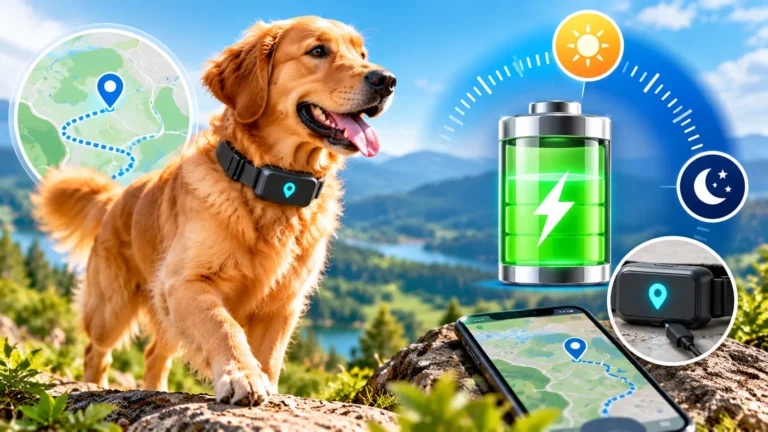
Bluetooth tags often have longer battery life because they can use low-power signals and may not need frequent satellite positioning or cellular transmissions. Dedicated GPS pet trackers usually have more demanding power requirements, particularly when configured for frequent location updates.

GPS tracker battery considerations
- Frequent live tracking can increase battery use.
- Weak network conditions may affect power consumption.
- Battery life differs by model, battery size and settings.
- Charging reminders and low-battery alerts are useful features to check.
Bluetooth tag battery considerations
- Some models use replaceable coin-cell batteries.
- Others use rechargeable or non-replaceable batteries.
- Actual life depends on model, usage and detection activity.
- Check battery replacement instructions and low-battery notifications.
Do not compare devices using battery-life claims alone. A tracker that lasts longer but cannot provide the type of location information you need may be a poor fit. Check manufacturer testing conditions and whether advertised endurance assumes normal use or a low-power mode.
6. Cost and Subscription Fees
Bluetooth tags are often cheaper to purchase and may not require a subscription for basic finding features. GPS pet trackers commonly cost more upfront and may require a recurring plan for cellular connectivity, location history, alerts or other app services.

| Cost consideration | GPS tracker | Bluetooth tracker |
|---|---|---|
| Initial purchase | Often higher for dedicated pet-tracking hardware | Often lower for basic tags |
| Ongoing fee | May require a monthly or annual service plan | Basic finding may be free; optional services vary |
| Replacement costs | Consider charging accessories, device wear and battery condition | Consider replacement batteries or replacing the tag |
| Long-term value | Depends on the value of wide-area tracking and included features | Depends on whether nearby or network-based finding meets your needs |
Before purchasing, calculate the total cost over the period you expect to use the device. Confirm whether the tracker requires a subscription, whether the plan works in your area, what happens if the subscription expires and whether any features require a higher-priced tier.
7. Features and Limitations to Understand

Features often available on GPS dog trackers
- Location updates through a compatible app.
- Live-tracking modes with more frequent updates on supported devices.
- Location history or route playback on selected models and plans.
- Virtual safe-zone alerts, often called geofencing.
- Activity summaries or other pet-monitoring features on some devices.
- Low-battery alerts and location sharing where supported.
These features are not universal. Verify the exact model’s capabilities, subscription requirements and supported regions before relying on them.
Features often available on Bluetooth trackers
- Nearby finding when the tag is within Bluetooth range.
- Sound alerts to help locate a tag nearby, if the model includes a speaker.
- Last-seen information or map-based finding through a supported app.
- Crowd-finding through a compatible device network on selected products.
- Compact designs and long battery life on many models.
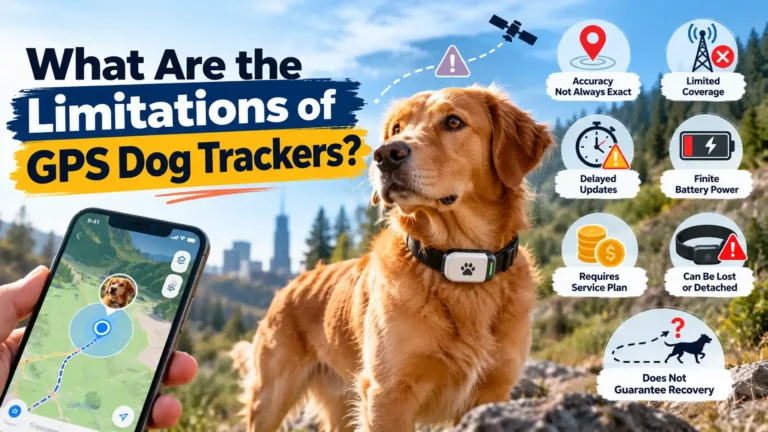
Important limitations of both technologies
Neither type guarantees recovery of a missing dog. GPS performance can be affected by poor satellite reception, weak cellular coverage, depleted batteries or service interruptions. Bluetooth tags depend on direct proximity or the availability of participating devices in the relevant finding network.
A tracker is a supplementary safety tool, not a replacement for a secure collar or harness, identification tag, microchip, supervision or appropriate training.
8. Which Tracker Should You Choose for Your Dog?
The best option depends on how your dog spends time outdoors, how far it might travel and what you need to know if it goes missing.

Choose a GPS tracker if…
- Your dog regularly hikes or explores large outdoor areas.
- You want location updates from a distance.
- Your dog has a history of escaping or roaming.
- You want supported live tracking or location-history features.
- You can maintain the battery and any required subscription.

Choose a Bluetooth tag if…
- You mainly want help finding a tag nearby.
- You want a compact device for everyday use.
- You prefer to avoid a cellular subscription where possible.
- You understand the limits of direct range and crowd-finding.
- You want an additional finding option rather than live pet tracking.
Can you use both GPS and Bluetooth?
Yes. Some owners use a dedicated GPS pet tracker as their main location tool and a separate Bluetooth tag as an additional finding aid. The two devices may complement each other, but a Bluetooth tag should not be assumed to provide a backup live GPS feed.
If you use two devices, make sure each is securely attached, suitable for your dog’s size and comfortable to wear. Avoid bulky attachments that could snag on branches, fencing or other objects.
9. Buying Checklist: What Should You Check Before Choosing?

Use this checklist to compare devices based on your real requirements rather than marketing claims.
- Tracking method: Confirm whether the product uses satellite positioning, cellular connectivity, Bluetooth, a crowd-finding network, radio or a combination.
- Coverage: Check cellular compatibility and service coverage in the places where you walk, hike or travel.
- Update frequency: Find out how often locations refresh in normal mode and live-tracking mode.
- Battery: Check realistic battery expectations, charging time, low-battery warnings and replacement options.
- Subscription: Confirm recurring fees, plan terms, supported countries and features that require payment.
- Fit and comfort: Check device weight, attachment security, dimensions and the manufacturer’s recommended dog size.
- Weather resistance: Verify the stated water-resistance rating and whether the device is suitable for swimming or only splashes and rain.
- App compatibility: Confirm compatibility with your phone, operating system and account.
- Privacy and sharing: Understand who can access location information and how location sharing can be disabled.
- Recovery plan: Keep current identification details and a recent photo of your dog, and know how to contact local shelters and animal-control services.
10. Tracking Technology Is Only One Part of Dog Safety

Even a capable tracker can stop providing useful updates if its battery is depleted, the communication network is unavailable or the device is damaged. A location shown on a map can also be delayed or approximate, so use it as one source of information rather than assuming it guarantees your dog’s exact position.
For a stronger safety routine:
- Keep your dog’s microchip registration and contact details current.
- Use a secure, correctly fitted collar or harness and an identification tag.
- Charge and test your tracker regularly.
- Learn what the app displays when the device is offline or has an old location.
- Keep your dog under appropriate supervision and use a leash where required.
- Know the steps to take if your dog goes missing before an emergency happens.
For more guidance, read our related guide: What to Do If Your Dog Goes Missing.
Frequently Asked Questions
1. Is a GPS dog tracker better than a Bluetooth tracker?
A GPS pet tracker is generally better when you need location updates over a wide area, provided it has the necessary satellite reception and communication coverage. A Bluetooth tracker is useful for finding a nearby tag and may offer additional help through a compatible crowd-finding network.
2. Can a Bluetooth tracker track my dog in real time?
Most standard Bluetooth tags do not provide continuous GPS-style tracking. They can help locate the tag when it is within Bluetooth range or when a compatible device detects it through a crowd-finding network. The timing and availability of updates depend on the product and nearby devices.
3. Does a GPS dog tracker need a monthly subscription?
Many GPS pet trackers require a subscription for cellular connectivity and app-based location services. Requirements differ by model. Check the manufacturer’s current plan details before buying.
4. Can a Bluetooth tracker find a dog that has run far away?
It may help if the tag is detected by a participating device in its finding network. However, it cannot guarantee an update, particularly in areas with few compatible devices. A dedicated GPS tracker with an appropriate communication service is generally more suitable for wide-area pet tracking.
5. Which tracker has the longest battery life?
Many Bluetooth tags last longer between battery replacements because they use less power. GPS pet trackers typically need more frequent charging, particularly with frequent location updates. Actual battery life depends on the model, settings and usage.
6. Does a GPS tracker work without cellular coverage?
A GPS receiver may still calculate its position without cellular coverage, but a tracker that relies on cellular data generally cannot send new locations to your phone through that network. Some specialist trackers use radio or satellite communication instead. Check the device’s exact communication method.
7. Can I attach a Bluetooth tag to my dog’s collar?
You can attach a compatible tag if it is secured properly and suitable for your dog’s size and activity. Check the manufacturer’s instructions and use it as a supplementary finding aid, not as a substitute for a dedicated pet tracker when live location updates are important.
8. Is a Bluetooth tag the same as a GPS tracker?
No. A standard Bluetooth tag uses short-range wireless communication and generally does not determine its own satellite-based position. A GPS tracker calculates its position using satellite signals and may use cellular, radio or another communication method to deliver location information.
9. Can I use a GPS tracker and a Bluetooth tag together?
Yes, if both devices are comfortable and securely attached. A GPS tracker can provide wide-area location updates, while a Bluetooth tag can serve as an additional nearby-finding option. Their capabilities remain separate.
10. Does either tracker guarantee that I will find my lost dog?
No. Both technologies have limitations. Battery failure, poor coverage, environmental obstacles and unavailable nearby devices can affect location reporting. Use tracking technology alongside identification, microchipping, supervision and a prepared lost-dog response plan.
Sources and Further Reading
The following resources explain Bluetooth item-finding technology and the differences between dedicated GPS pet trackers and Bluetooth tags. Always consult the documentation for the exact product you intend to use.
- Apple Support: Use AirTag and Find My to keep track of personal items — explains nearby finding, Precision Finding and device requirements.
- Apple AirTag official product information — describes Bluetooth communication and the Find My network.
- American Kennel Club: Dog GPS Trackers vs. Bluetooth Trackers — an overview of pet-tracking use cases and limitations.
Editorial note: Features, coverage, subscription terms and battery specifications can change. Confirm current product documentation before making a purchase.