What Is the Difference Between GPS Positioning and Live Tracking?
GPS positioning tells a tracker where it is. Live tracking helps you follow reported location updates through an app. Although these terms are closely related, they describe different parts of the tracking process.
Discover how satellite positioning works, how live updates reach your phone, and why a GPS tracker may not always show your dog’s current location.
Understand the Difference
When shopping for a GPS dog tracker, you may see descriptions such as GPS positioning, real-time tracking, live location and location history. These features sound similar, but they do not all mean the same thing.
GPS positioning is the process of estimating a device’s geographical location using satellite signals. Live tracking describes a tracking experience in which location reports are delivered frequently enough to help you follow movement. It depends on more than GPS alone: the device must also obtain positions, communicate them and display the latest available information in the app.
1. What Is the Main Difference Between GPS Positioning and Live Tracking?
The main difference is that GPS positioning calculates a location, while live tracking involves receiving repeated location reports that let you monitor movement.
GPS Positioning
Estimates where a device is at a particular moment using satellite navigation signals or other supported positioning methods.
Live Tracking
Provides repeated location reports so an owner can follow a dog’s movement through a compatible app or receiver.
Tracking App
Displays the latest location information received by the service. The marker may be delayed or outdated if a new report has not arrived.
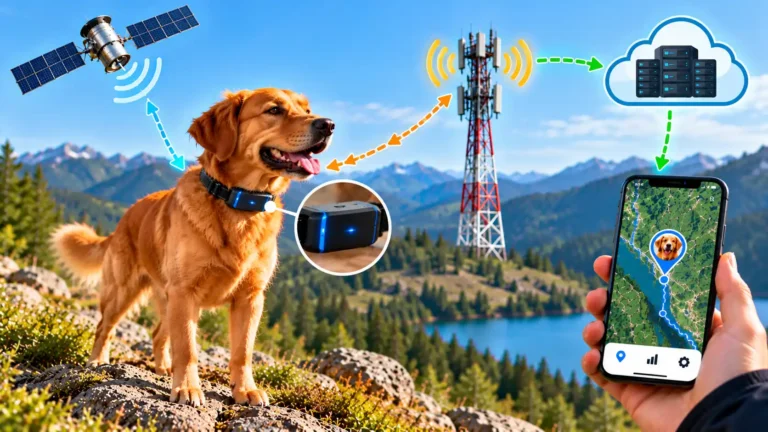
For example, a tracker may calculate a position using GPS satellites while your dog is walking in a field. If it sends that position to your phone and continues sending new positions as your dog moves, you can follow its reported journey through live tracking.
If the tracker loses cellular coverage, it may still calculate its position but be unable to send new updates to the app. In that situation, GPS positioning may remain possible while live remote tracking is interrupted.
2. What Is GPS Positioning?
GPS stands for Global Positioning System. It is a satellite-based navigation system that provides positioning and timing information to compatible receivers.
A GPS receiver, such as the one inside a compatible dog tracker, receives signals from multiple satellites and uses them to estimate its position. Other global navigation satellite systems may also be supported by some devices.
How GPS positioning works
- The tracker receives signals from navigation satellites.
- Its receiver analyses the signals and their timing.
- The device calculates an estimated geographical position.
- The position can then be stored, displayed or transmitted, depending on the device’s capabilities.
GPS positioning does not, by itself, guarantee that a location will be sent to your smartphone. A separate communication method is generally needed for remote access to the tracker’s position.
Does GPS positioning require cellular service?
No. GPS positioning itself does not require a cellular connection or an internet connection. The receiver needs suitable satellite signals and enough power to operate.
However, if you want to see the tracker’s current position remotely in a smartphone app, the device usually needs a way to transmit that information. Many consumer dog trackers use cellular networks for this purpose.
For an overview of the technology, visit GPS.gov.
3. What Is Live GPS Tracking?
Live GPS tracking is the repeated reporting of a device’s location so that an owner can follow its movement over time. For dog owners, this can help show where a dog has travelled and where the tracker was most recently reported.
In a typical cellular GPS dog tracker, live tracking involves several stages.
1. Obtain a Position
The tracker calculates a location using satellite signals or another supported positioning method.
2. Send the Report
The device transmits location information through a compatible communication system, often a cellular network.
3. Display the Update
The tracking service makes the report available in the app, which displays the latest location it has received.
Live tracking does not necessarily mean continuous, uninterrupted updates every second. The frequency depends on the model, tracking mode, signal conditions and service design.
Related reading: How does a GPS dog tracker send its location to a phone?
4. GPS Positioning vs Live Tracking: Key Differences
Although GPS positioning and live tracking work together in many dog trackers, they have different purposes and requirements.
| Feature | GPS Positioning | Live Tracking |
|---|---|---|
| Main purpose | Estimates the device’s geographical position. | Provides repeated location reports for following movement. |
| Uses satellite signals | Yes, for GPS-based positioning. | Often uses GPS or another positioning system as part of the process. |
| Requires cellular coverage | No, not for GPS positioning itself. | Often requires cellular connectivity for remote app updates, unless another communication method is used. |
| Shows movement over time | Not necessarily; one position is only a location estimate at a particular time. | Yes, when sufficient location reports are received. |
| Depends on update frequency | Not in the same way as a stream of repeated reports. | Yes. The interval between reports affects how closely movement can be followed. |
| Can work without internet? | Yes, if satellite reception and device power are available. | Remote live updates generally need a working communication path; local receiver systems may work differently. |
| Can show an old location? | A saved position can become outdated as the device moves. | Yes, if new reports are delayed or unavailable. |
The key takeaway is that GPS positioning is one component of a tracking system. Live tracking relies on the ability to obtain and deliver location reports frequently enough for the intended use.
5. Does Live Tracking Mean More Accurate GPS Positioning?
Not necessarily. Update frequency and positioning accuracy are two different measures.
Positioning accuracy describes how closely a location estimate matches the tracker’s actual position at the time it was recorded. Update frequency describes how often the device reports location information.
A tracker can provide frequent updates while still experiencing positioning errors caused by buildings, dense foliage, difficult terrain or poor satellite reception. A tracker can also obtain a good position but deliver it too late for you to know where a moving dog is now.
Why both factors matter
- Accuracy: Helps determine how close the reported coordinates are to the tracker’s position at the time of measurement.
- Freshness: Indicates how recently that position was recorded.
- Communication delay: Affects how quickly the report reaches the app.
- Update interval: Determines how much time may pass between consecutive reports.
For example, a location recorded accurately several minutes ago may no longer be useful for following a dog that is moving quickly. A recent update can be more useful, but only if the position is reliable enough for the situation.
Read more: How accurate are GPS dog trackers?
6. How Cellular Coverage Affects Live Tracking
Many consumer GPS dog trackers use satellite signals to calculate their position and cellular networks to send that information to the tracking service.
When mobile coverage is weak or unavailable, the tracker may still be able to calculate a position but be unable to report it to your phone. Your app may continue displaying the last successfully transmitted location.
| Condition | GPS positioning | Remote live tracking |
|---|---|---|
| Good satellite reception and cellular coverage | Usually able to calculate positions under normal operating conditions. | Can generally deliver updates, subject to the device and service. |
| Good satellite reception but no cellular service | May continue to calculate a position. | May stop receiving fresh reports until a suitable connection returns. |
| Poor satellite reception but cellular service available | May struggle to calculate a fresh satellite-based position. | Cannot reliably deliver a new GPS position if one has not been obtained, though other positioning methods may be supported. |
| Phone has no internet connection | The tracker may still calculate its position. | The app may be unable to retrieve the newest remote report. |
Some products store location records offline, and some specialist systems use radio or satellite communication. These capabilities vary, so do not assume every GPS dog tracker will continue delivering live updates outside cellular coverage.
Related guide: Can GPS dog trackers work without cellular coverage?
7. Common GPS Dog Tracker Modes
Manufacturers use different names for tracking modes, but many devices offer options intended to balance location reporting, power consumption and everyday convenience.
Standard tracking
Standard mode is generally designed for routine use. The tracker reports positions according to its default settings, which may be less frequent than its most intensive tracking mode.
Live or active tracking
Active tracking is intended to provide more frequent location reports when you want to follow your dog’s movement. It may be useful during walks or when checking a changing location, but it cannot remove network or satellite limitations.
Battery-saving mode
Some devices reduce reporting or communication activity to extend battery life. This may mean that the app receives fewer updates or that the device behaves differently when the dog is stationary.
Lost-dog or recovery mode
Some trackers offer a mode designed to assist a search for a missing dog. Its exact effect on update frequency, alerts and battery use depends on the model.
8. What Should You Look for When Buying a GPS Dog Tracker?
If you want reliable location information, compare the complete tracking system rather than looking only at claims about GPS or live tracking.
- Check the stated positioning technology and supported communication networks.
- Compare update intervals in standard and active tracking modes.
- Confirm whether the app displays the time of the latest location report.
- Review coverage in the areas where your dog usually walks.
- Check battery-life estimates for your intended tracking settings.
- Find out what happens when cellular coverage is lost.
- Confirm whether offline location history is available.
- Review subscription requirements and the total cost of ownership.
- Check the tracker’s size, weight, fit and durability for your dog.
For a wider overview of the available features, read What features can a GPS dog tracker provide?
9. Why Is My GPS Dog Tracker Not Showing Live Updates?
If the app shows an old position or the tracker appears offline, the issue may be related to positioning, communication, power or the app itself.
| Problem | Possible cause | What to check |
|---|---|---|
| The map shows an old position | No new location report has reached the app. | Check the timestamp, coverage and tracking mode. |
| The tracker appears offline | Mobile coverage, subscription status or battery may be an issue. | Check the connection, account status and battery level. |
| The position appears inaccurate | Satellite reception or the surrounding environment may affect positioning. | Test in a suitable open area and review the manufacturer’s instructions. |
| The app is not refreshing | The phone may have an internet or app problem. | Check the phone’s internet connection and app status. |
| Battery drains quickly | Frequent reporting or demanding signal conditions may increase power use. | Review tracking settings and battery guidance. |
Follow the manufacturer’s troubleshooting instructions before resetting the device. If the issue continues, contact the tracker provider.
Related guide: How often do GPS dog trackers update their location?
10. How to Use GPS Tracking Responsibly
GPS positioning and live tracking can help you monitor your dog’s reported location, but neither guarantees that you can always locate your dog instantly.
- Check the last-update time before relying on the displayed position.
- Charge the tracker before longer outings.
- Test the device and its alerts in a safe environment.
- Keep your dog’s identification tag and microchip details up to date.
- Understand how the tracker behaves when network coverage is lost.
- Use appropriate leads, harnesses and secure fencing where necessary.
- Use location information alongside a wider search plan if your dog goes missing.
If a tracker stops updating, do not assume your dog is still at the last reported location. Treat that position as a useful lead and take appropriate steps to find your dog.
Read our guide: What to do if your dog goes missing.
Frequently Asked Questions
What is the difference between GPS positioning and live tracking?
GPS positioning estimates a device’s location using satellite signals. Live tracking involves receiving repeated location reports so you can follow movement through a compatible app or receiver.
Can GPS positioning work without live tracking?
Yes. A tracker can calculate its position without transmitting it to a remote app. Whether it can store that position for later use depends on the device.
Does live tracking require cellular coverage?
Many consumer GPS dog trackers use cellular networks for remote updates. Other systems may use radio or satellite communication, so the requirement depends on the product.
Does live tracking mean the location updates every second?
No. The term does not guarantee continuous or second-by-second updates. Check the manufacturer’s stated reporting interval and the timestamp shown in the app.
Is live tracking more accurate than GPS positioning?
Not necessarily. Live tracking describes repeated reporting, while accuracy describes how closely a location estimate matches the actual position at the time it was recorded.
Why does my live tracking map show an old location?
The tracker may have lost connectivity, may be unable to obtain a fresh position or may be operating in a mode with less frequent updates. Check the last-update time and device status.
Does live tracking use more battery power?
Frequent location reporting may consume more power, depending on the device and conditions. Check battery-life estimates for the tracking mode you intend to use.
Can a GPS dog tracker show location history without live tracking?
Some devices store location records or routes that can be reviewed later. The availability and detail of location history depend on the model and service.
Can a GPS tracker show my dog’s exact location?
It provides a location estimate, not a guarantee of an exact position. Satellite reception, environmental conditions, device design and update delays can affect the information displayed.
Which matters more: positioning accuracy or update frequency?
Both matter. Accuracy affects how close the reported coordinates are to the actual position, while update frequency and freshness affect how useful the information is for following a moving dog.
Final Verdict: GPS Positioning vs Live Tracking
GPS positioning and live tracking work together, but they are not the same thing. Positioning helps a device estimate where it is. Live tracking makes repeated location reports available so an owner can follow movement over time.
For a GPS dog tracker to provide useful live updates, it must obtain location information and communicate it through a supported system. Update frequency, satellite reception, cellular coverage, battery life and app connectivity can all affect the result.
When choosing a tracker, compare its positioning technology, communication method, reporting intervals and battery performance. Understanding these differences helps you select a device that suits your dog’s environment and your tracking needs.
Sources and Further Reading
- GPS.gov — official information about GPS positioning and satellite navigation.
- Federal Communications Commission — information about wireless communication services.
- American Kennel Club — dog care and safety resources.
For specific update intervals, supported communication methods and accuracy specifications, consult the official documentation for the tracker you are considering.